
AI Governance for Australian Enterprises: Frameworks, Risk, and Implementation Considerations
Most organisations discover their AI governance gaps when something goes wrong and nobody can establish accountability. This guide maps the seven domains of enterprise AI governance and explains why building governance into procurement from the start is the only approach that reliably works.

Most organisations do not discover their AI governance gaps by anticipating them. They discover them when a model update changes something the organisation relied on, when a privacy question cannot be answered because no audit trail exists, or when an AI-generated output causes a problem and nobody can establish accountability.
By that point, governance is crisis management.
This guide is written for IT, risk, legal, and procurement leaders in Australian organisations who are deploying enterprise AI and seeking to understand what governance actually involves in practice: not as a compliance exercise, but as an operational discipline that determines whether AI delivers sustained value or accumulates unchecked risk.
Enterprise AI governance is the structured system of controls, accountability, monitoring, and oversight that governs how AI systems are acquired, deployed, and managed within an organisation over time. It spans vendor selection, data handling, access controls, output accountability, model lifecycle management, regulatory compliance, and ongoing operational oversight.
AI governance is not a single control. It is a set of interlocking policies, processes, and accountability structures that determine how AI is acquired, used, monitored, and managed over time. Its scope extends from vendor selection through to daily operational oversight. Organisations that treat governance as a post-deployment concern typically find that the cost of retrofitting controls into an embedded system is substantially higher than the cost of building governance into procurement and deployment from the start.
Enterprise AI governance operates across seven domains: acquisition and procurement, data, access and permissions, output and accountability, model lifecycle, regulatory compliance, and operational oversight. Each addresses a distinct category of risk. Together, they form the governance infrastructure that enterprise AI calls for.
Why AI Governance Differs From Existing IT Governance
Much traditional IT governance is designed around systems whose behaviour is comparatively stable, testable and version-controlled. Deterministic components generally produce the same outputs from the same inputs under the same configuration.
Generative AI and many machine-learning systems do not always operate this way. Large language models and some AI-enabled platforms can produce probabilistic outputs influenced by the model version, context, configuration and sampling settings. The same input can generate different outputs depending on model state, context, and configuration. Vendors may update models without requiring explicit customer approval, and those updates can alter output behaviour in ways that affect existing workflows, validations, and decisions.
This breaks three foundational assumptions of traditional IT governance.
The first assumption is that system behaviour is stable between approved changes. AI model updates can challenge this assumption. A vendor can update the underlying model that generates outputs without issuing a software version number or requiring a change approval process. The system changes. The change management process built around software governance does not detect it.
The second assumption is that accountability is clear. In traditional software, if an error occurs, it is possible to trace whether the software behaved as specified. With AI, outputs are generated probabilistically, responsibility and potential liability may be allocated or shared between the vendor, deploying organisation and users depending on the circumstances, contractual arrangements and applicable law, and an error may not be traceable to a single cause. Existing incident management frameworks often lack the mechanisms to investigate AI failures effectively.
The third assumption is that compliance can be validated at procurement. Security certifications may provide point-in-time assurance against defined criteria, while service level agreements establish contractual performance commitments. Neither replaces ongoing governance as the system, use case and risk environment evolve. AI systems may change over time through model, configuration, data, feature or vendor updates. A governance framework covers ongoing compliance, not just initial conformance.
Enterprise AI governance is most effective when it accounts for these differences. Applying existing IT governance frameworks without modification typically leaves material risks unaddressed.
The Seven Domains of Enterprise AI Governance
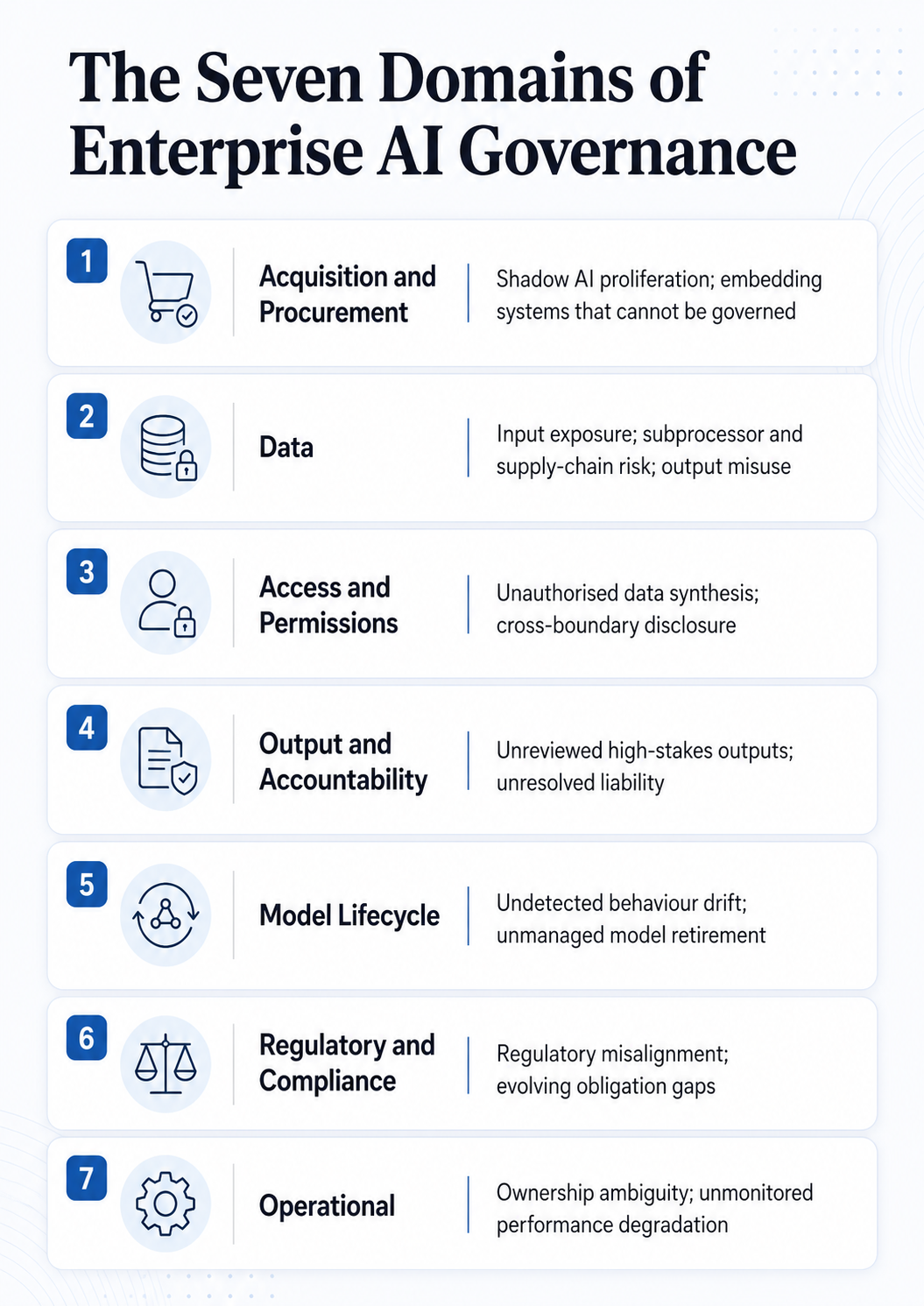
1. Acquisition and Procurement Governance
AI governance begins before deployment. Organisations that establish governance requirements as procurement criteria, rather than as post-deployment additions, avoid the structural problem of embedding ungovernable systems.
Acquisition governance defines which AI systems are permitted within the organisation, who has authority to approve AI procurement, and what baseline criteria all AI vendors are expected to meet before selection. This typically includes data handling standards, security certifications, audit capability, and contractual commitments around training data exclusion.
Without acquisition governance, AI tools proliferate without oversight. Individual teams adopt consumer or departmental AI tools that do not meet enterprise standards. Shadow AI, meaning the use of unapproved AI tools within an organisation, is not primarily a technology problem. It is an acquisition governance failure.
Procurement criteria that include governance capability as a gating requirement change vendor selection outcomes. Vendors that cannot demonstrate audit logging, data residency or offshore-processing controls where required by the organisation's legal, regulatory or risk requirements, or administrative governance capability are removed before functional evaluation begins. This is not a conservative approach. It is the disciplined sequencing that the enterprise AI procurement framework calls for.
2. Data Governance for AI
AI systems process, generate, and sometimes retain data in ways that create distinct governance obligations.
The data governance concerns specific to AI fall into three categories.
Input data governance addresses what data can be submitted to AI systems. Employees using conversational AI interfaces may introduce customer personal information, commercially sensitive content, or confidential third-party data through prompts, attachments, and workflow integrations. Governing input data involves defining what data may and may not be submitted to AI systems, with guidance that is operationally practical. Prohibitions that cannot be enforced create the appearance of governance without the substance.
Processing and storage governance addresses where data goes once it enters an AI system. Enterprise AI vendors typically offer contractual commitments about data retention and training exclusion. Well-structured procurement typically addresses these commitments explicitly and verifies that they extend to subprocessors, meaning third parties who may process data on behalf of the primary vendor. Data residency and offshore-processing arrangements, which may engage obligations under the Australian Privacy Principles depending on the data flows and disclosures involved, are commonly verified at the infrastructure level, not just the contractual level.
Output data governance addresses AI-generated content. Outputs from AI systems may reproduce information the organisation did not intend to disclose, may contain inaccuracies presented with apparent authority, or may create intellectual property questions. Output data governance involves policies addressing how AI-generated outputs are labelled, validated, and used.
3. Access and Permission Governance
Access governance for AI is more complex than for traditional software because AI systems can synthesise and surface information across boundaries that were not explicitly modelled.
A conventional access control framework grants a user access to specific data sources based on their role. An AI system integrated with multiple data sources may synthesise information in ways that reveal insights a user would not have obtained by accessing each source individually. The AI behaves within permission boundaries at the data source level but may create information disclosure risk at the synthesis level.
Effective access governance involves bounding the AI's retrieval behaviour by the same permission model that governs direct access. Where knowledge graph structures, retrieval indexing, or agentic capabilities are in use, permission propagation is commonly verified as part of deployment rather than assumed.
Access governance also applies to external-facing AI. Organisations that deploy AI in customer or partner-facing contexts carry obligations that extend beyond internal workforce governance. AI systems should be configured and tested to minimise unauthorised disclosure risk. Testing this boundary under realistic conditions before deployment is a standard governance step.
When non-functional access and permission requirements are not defined before vendor evaluation begins, organisations discover gaps after selection, at a point when the cost of addressing them is higher. The work of defining those requirements is a core part of what organisations typically address before vendor engagement.
4. Output and Accountability Governance
AI outputs require clear accountability, particularly where they may materially affect individuals, customers or the organisation. Australian government guidance emphasises maintaining appropriate human oversight, and sector regulators may expect human involvement in higher-risk decisions. This does not mean that every AI output must be manually reviewed; the level of supervision should be proportionate to the use case and its potential consequences.
Enterprise AI contracts often allocate significant responsibility for reviewing and acting on outputs to the customer. However, responsibility and legal liability should not be assumed to rest exclusively with the deploying organisation. Depending on the circumstances, obligations may be shared across the vendor, deploying organisation and users, and statutory obligations cannot necessarily be excluded through contract.
Output governance establishes the controls that make this accountability manageable. This means defining which output types call for human review before being acted upon, what validation steps apply to high-stakes outputs, how escalation works when output quality is uncertain, and who has authority to approve AI-generated content for use in specific contexts.
The practical risk of weak output governance is not that AI will produce obviously wrong answers. It is that AI will produce plausible answers that are subtly wrong, and that the workflow does not include a step where a qualified person would detect the error before it matters.
Supervisory controls are the mechanism. They do not involve reviewing every AI output. They involve designing workflows so that high-stakes outputs are reviewed by someone with the knowledge to assess them, and that the AI is not positioned as the final authority in decisions where errors carry material consequences.
5. Model Lifecycle Governance
Enterprise AI systems should not be assumed to remain static after deployment. Vendors may update models, outputs may shift, and capabilities and features may change or be deprecated. Organisations that do not monitor these changes discover their consequences rather than managing them.
Model lifecycle governance involves establishing processes for detecting model changes, assessing their impact, and managing transitions when output behaviour shifts materially.
The core challenge is that model updates may not be disclosed with enough specificity for an organisation to assess their impact on its particular use cases. A vendor may announce that a new model version has been deployed without specifying how output behaviour has changed for the particular use cases an organisation depends on. Impact assessment requires the organisation to test its own workflows against the updated model, a step that traditional change management processes were not designed to accommodate.
Regression testing for AI workflows is an emerging practice. One approach involves defining what acceptable output looks like for a representative set of test inputs, then re-running those tests after model updates to detect degradation. This is not feasible for every use case, but it is appropriate for workflows where output consistency is critical: compliance reviews, financial analysis, or any context where errors carry material consequences.
Lifecycle governance also addresses model retirement and migration. Vendors periodically retire older models in favour of newer ones. Organisations that have built workflows around specific model behaviour typically plan for migration before it is forced. When migration is reactive rather than planned, the disruption cost, including retesting, reconfiguration, and retraining, is typically higher than it would have been under a managed transition.
Agentic AI deployments, where AI systems take sequential actions with minimal human intervention between steps, call for particularly rigorous lifecycle governance. Model updates that alter reasoning behaviour or tool use in agentic workflows can produce material operational consequences with limited visibility. Governance frameworks for agentic AI are addressed in a dedicated cluster article in this series.
6. Regulatory and Compliance Governance
Enterprise AI does not operate outside Australia's existing legal and regulatory environment. Depending on the organisation and use case, relevant requirements may arise under privacy, consumer protection, employment, anti-discrimination, intellectual property, cybersecurity and sector-specific frameworks.
The Australian Government's Guidance for AI Adoption provides a useful current reference point for organisations developing AI governance structures. It emphasises accountability, understanding impacts, managing risk, transparency, testing and appropriate human oversight. Organisations operating in regulated sectors may also need to address additional regulator or industry requirements.
For procurement teams, the practical task is to identify which obligations are relevant to the proposed AI use case and translate them into clear vendor, contractual and operational requirements. These may include requirements relating to data handling, offshore processing, access controls, audit logging, model changes, output validation, incident response, human oversight and accountability.
The applicable requirements will vary between organisations and deployments. Material or higher-risk use cases should be assessed with appropriately qualified legal, privacy, cybersecurity, risk and regulatory specialists.
7. Operational Governance After Go-Live
The organisational tendency after deployment is to declare success and move on. Governance responsibility transfers to a team. A budget is allocated. The system runs.
What is missing is the ongoing oversight structure that enterprise AI requires.
Operational governance defines who monitors the AI after go-live, what they are monitoring for, what constitutes a triggering event for review or escalation, and who has authority to take action. It includes usage monitoring, output quality review, licence management, and vendor relationship oversight.
The organisations that manage this effectively treat operational governance as a defined function with explicit resourcing, not as a shared responsibility that everyone assumes someone else is managing. When operational ownership is unclear, governance gaps accumulate without being identified until they produce a visible problem.
Operational governance and value realisation are connected activities. The same usage monitoring that identifies governance concerns also identifies where the AI is delivering value, where adoption is stalling, and where use case design needs refinement. Governance monitoring and performance monitoring often draw on overlapping data, but they serve distinct and complementary purposes.
Building a Governance Structure: What Good Looks Like
AI governance structures that work share common features. They are not bureaucratic overlays. They are operational functions with clear ownership, defined scope, and practical authority.
Ownership is explicit. Someone is accountable for AI governance. This responsibility should be assigned deliberately rather than assumed to sit with the person who procured the AI or uses it most. It is the person or team responsible for ensuring the governance framework is implemented, monitored, and updated. In larger organisations, this may be a dedicated AI governance function. In smaller organisations, it may sit within IT, legal, or risk. Accountability is most effective when explicitly assigned rather than assumed.
Policy is practical. Governance policies that cannot be operationalised may create false assurance rather than reducing risk. A policy that prohibits staff from submitting personal information to AI systems is useful only if it is accompanied by guidance on what constitutes personal information in practice, and if the AI systems deployed offer usage controls that support enforcement. Policies written without reference to operational reality may document expectations without providing effective governance.
Monitoring is ongoing. Enterprise AI governance is not a deployment checklist. It involves recurring review of usage patterns, output quality, vendor compliance, regulatory developments, and organisational changes that affect AI risk. The frequency and scope of monitoring is typically proportionate to the risk profile of the AI in use.
Escalation is defined. When governance monitoring identifies a problem, whether an output quality incident, a model update that has altered critical workflows, or a data handling concern, a clearly defined escalation path matters. Who is informed? Who has authority to act? What is the response timeline? Governance structures that lack defined escalation processes typically produce slow, inconsistent responses that allow problems to compound.
Governance informs procurement. The governance framework is most effective when it connects to the procurement process. Insights that emerge from operational governance experience, including observations about vendor behaviour, contractual gaps, and data handling shortfalls, typically feed back into future procurement decisions and contract renewals. Governance that does not influence procurement eventually becomes disconnected from the risk it is meant to manage.
Governance as a Procurement Requirement, Not a Post-Deployment Addition
A common structural mistake in AI governance is treating it as a post-deployment concern. Governance frameworks are built after deployment because the procurement process did not require governance capability as a vendor selection criterion.
The consequence is that organisations end up with AI systems that are not fully governable. Platforms that do not provide adequate audit logging. Systems that do not support the access controls needed for compliance. Vendors that do not disclose model update schedules in ways that enable lifecycle management. Contracts that do not offer protections adequate for the organisation's regulatory environment.
Retrofitting governance capability into an embedded system is often expensive and in some cases operationally impractical. Requiring governance capability during procurement is a selection criterion. Vendors that cannot meet it are removed before functional evaluation begins. This is the same principle that applies to non-functional requirements in a well-structured enterprise AI RFP.
The enterprise AI RFP blueprint addresses how governance requirements translate into RFP structure and evaluation weighting. The total cost of ownership framework addresses the cost implications of governance, including how governance tooling, audit infrastructure, and operational oversight contribute to the true cost of AI deployment. Governance is not separate from commercial and procurement decision-making. It is a dimension of both.
The Governance Cluster: What This Guide Connects To
This guide provides the framework. The cluster articles in this series address each major governance domain in operational depth:
- Enterprise AI governance frameworks for Australian organisations: The Australian-specific framework structure, including how to map governance requirements to the APPs and the Guidance for AI Adoption
- AI governance for enterprise model lifecycle management: How to build detection, testing, and migration processes for model updates in production environments
- Agentic AI governance: risk and strategy for enterprise deployments: The specific governance challenges created by autonomous AI agents, including approval workflows, action boundaries, and failure mode management
- The cost of enterprise AI governance: what to budget for: How governance tooling, internal labour, and operational oversight contribute to total cost of ownership
Each cluster article links back to this guide. Pillar pages are updated as cluster articles are published.
The Governance Imperative
Enterprise AI without governance is an unmanaged risk. The outputs exist. The data moves. The models change. The decisions are made. But without the controls, accountability structures, and monitoring mechanisms that governance provides, organisations cannot assess whether the AI is performing within acceptable boundaries, cannot investigate when it does not, and cannot demonstrate to regulators, auditors, or customers that it is being operated responsibly.
Australian enterprises deploying AI in 2026 operate in a regulatory environment that continues to evolve, with increasing attention being given to AI-related risk, governance, and accountability. The organisations building governance structures now are not doing compliance theatre. They are building the operational infrastructure that may determine whether their AI investment remains viable as regulatory and commercial expectations increase.
The question is not whether enterprise AI requires governance. It always has. The question is whether the organisation builds that governance into procurement and deployment, or discovers the need for it through problems it could have prevented.
This article provides general informational, commercial, and procurement commentary only and should not be relied upon as legal, regulatory, cybersecurity, privacy, financial, or other professional advice. It reflects information available at the date it was last reviewed (July 2026). Laws, regulatory requirements, government guidance, industry standards, and accepted practices relating to artificial intelligence may change over time. While reasonable care has been taken in preparing this article, the information may not remain complete, current, or suitable for every organisation or circumstance. Readers should verify the current legal and regulatory position and obtain advice from appropriately qualified legal, privacy, cybersecurity, regulatory, or other professional advisers before acting on the information or making decisions that may carry material consequences.