
Enterprise AI Operating Models: Understanding the Cost Beyond the Licence
Most organisations start by comparing AI licence costs. As AI moves from productivity tools into workflow automation and agent platforms, the operating model becomes a more significant cost driver than the licence. This article maps the three models and the procurement implications of each.

An organisation evaluates three enterprise AI platforms. The conversation centres on licence costs: per-user pricing, annual commitment terms, volume discounts. A platform is selected based on a per-seat comparison. Implementation begins.
Six months later, the same organisation is discussing AI agents, workflow automation, system integrations, approval processes, and governance structures. The cost conversation has changed completely. Licence costs, which drove the original procurement decision, now represent a relatively small share of what the deployment is actually costing.
This pattern can emerge as enterprise AI programmes expand. The licence comparison that drives many initial procurement decisions becomes less relevant as organisations move beyond individual productivity use cases into workflow automation and agentic systems. The more useful question, often asked too late, is not which AI platform is cheapest but what operating model the organisation is trying to build.
This article maps three enterprise AI operating models commonly seen in the market, the cost categories associated with each, and the procurement considerations that differ between them.
What Is an Enterprise AI Operating Model?
An enterprise AI operating model describes how AI is deployed within an organisation: what it does, how it interacts with systems and people, and what infrastructure and governance is in place to support it.
For the purposes of this article, the three models below are conceptual deployment archetypes rather than a universal industry taxonomy. Organisations may operate more than one model at the same time, and the boundaries between assistants, workflows and agents are increasingly fluid.
The operating model is distinct from the AI platform. Two organisations may use the same platform and run very different operating models. One deploys it as a staff productivity tool. The other deploys it as a participant in automated business processes. The platform licence may be identical. The total cost, governance complexity, and implementation effort are not.
Understanding which operating model an organisation is building toward is a more useful input to procurement than platform feature comparison alone.
Operating Model 1: Enterprise AI Assistant
The Enterprise AI Assistant is a common entry point for enterprise AI deployment.
AI primarily supports individual staff productivity. Staff interact with AI through a chat interface or embedded tools to complete tasks: drafting, summarising, searching, retrieving information, generating content. The AI responds to prompts. Staff evaluate the outputs and decide what to do with them.
Why organisations adopt this model. The primary motivation is broad workforce productivity with fast deployment, a predictable commercial structure, and comparatively limited disruption to existing systems and processes.
Characteristics. This model tends to be the fastest to deploy and the most predictable in terms of commercial structure. Per-seat or per-user licensing is a common pricing model in this category, though consumption-based and hybrid structures are available from some providers. In basic chat-based deployments, consumption may be relatively bounded and closely linked to user activity. Cost predictability can reduce where advanced capabilities, agents, connectors or separately metered usage are enabled.
Governance requirements, while meaningful, centre primarily on data handling policies and user behaviour rather than system-level controls.
Primary cost categories. Direct costs often centre on licence subscriptions, although consumption-based and hybrid pricing models are also increasingly common. Indirect costs include training and change management, security review and configuration, administrative overhead, and ongoing user support. Integration costs are often lower where the assistant relies on native productivity-suite access and existing, appropriately governed data sources. Costs can increase where custom connectors, retrieval layers, permissions remediation or actions into business systems are required.
Procurement considerations. Procurement focus in this model tends to concentrate on security architecture, data handling, user adoption support and commercial terms including volume discounts and renewal provisions. Governance requirements are often less complex in a limited, low-impact assistant deployment, but the appropriate level depends on the data involved, the use case, the people affected and the consequences of error. Sensitive or consequential use cases can require controls beyond standard SaaS procurement.
Operating Model 2: AI with Workflow Automation
As organisations identify use cases where AI can participate in business processes rather than only respond to individual queries, the operating model shifts.
In this model, AI is involved in workflows that move documents, information, or decisions through defined process steps. Examples include contract review workflows that route documents based on AI-generated risk flags, HR onboarding processes that use AI to verify completeness and trigger next steps, and approval support processes where AI summarises and contextualises submissions for human decision-makers.
The AI is no longer only responding to user prompts. It is participating in a process that produces outputs with operational consequences.
Why organisations adopt this model. Organisations typically move toward this model when they have identified document-heavy, repetitive, or decision-support processes where AI participation can reduce handling time or improve consistency, and where the value case justifies the additional implementation effort.
Characteristics. This model can offer higher value potential than the assistant model but involves greater implementation effort. Workflows call for design, testing, and ongoing maintenance. Integration points with existing systems introduce dependencies. Governance requirements expand to cover process logic, escalation paths, and output handling.
Primary cost categories. Direct costs include platform licences, workflow tooling, and AI consumption (which in this model may be based on volume of documents or transactions processed rather than user seats). Indirect costs expand significantly to include workflow design and documentation, integration development and testing, governance framework development for the specific processes involved, and change management for the staff and teams whose processes are affected.
Procurement considerations. Procurement consideration in this model expands to include workflow ownership questions (who is accountable for the process the AI participates in), integration requirements and timelines, governance controls covering process logic and exception handling, and support responsibilities for the workflow infrastructure.
Operating Model 3: Enterprise Agent Platform
When AI is deployed to operate across multiple systems (executing multi-step tasks, accessing data sources, triggering actions, and interacting with other systems without step-by-step human instruction), the organisation is operating an agent platform.
A useful distinction from the previous model is that workflow AI typically follows predefined process paths, whereas agent platforms are designed to make decisions, coordinate multiple systems, and dynamically determine how tasks are completed within defined constraints.
Agent platforms may involve orchestration layers that coordinate multiple AI models or agents, each responsible for different tasks or domains. Technologies used in this model include managed services such as Microsoft Foundry Agent Service and Amazon Bedrock AgentCore, agentic application platforms such as Dify, and orchestration frameworks and runtimes such as LangGraph. Examples of use cases include procurement agents that monitor spend, identify anomalies, and route exceptions; service desk agents that triage, categorise, and respond to requests; and finance agents that process, validate, and route transactions. Agentic AI governance at this level is materially more complex than in the assistant or workflow models.
Why organisations adopt this model. Organisations move to this model when they are targeting cross-system automation at a scale and complexity that exceeds what workflow tooling alone can support, or when they want the flexibility to build and deploy multiple AI capabilities across different business functions from a common platform.
Characteristics. This model offers significantly greater flexibility than the assistant or workflow models, with correspondingly greater complexity. The organisation takes on meaningful architectural dependencies. AI behaviour is harder to monitor and govern than in a chat interface model. Support requirements increase. The cost structure is less predictable, particularly for consumption-based components.
Primary cost categories. Direct costs include orchestration platform licences, model consumption (which may span multiple models at varying cost points), cloud infrastructure and storage, and data pipeline costs. Indirect costs expand substantially to include engineering and architecture design, model configuration, monitoring and observability infrastructure, governance framework development, and ongoing operational support. Consumption costs in this model can scale significantly with usage and are often difficult to forecast at procurement stage.
Procurement considerations. Procurement focus in this model expands to include scalability architecture, consumption exposure and cost modelling, architecture compatibility with existing systems, data portability and exit provisions, and the vendor's post-go-live support model. The enterprise AI procurement process at this level differs substantially from standard SaaS procurement in scope, commercial structure, and risk profile.
Enterprise AI Capability Maturity
As organisations move from AI assistants to workflow automation and agent platforms, many establish shared organisational capabilities to manage AI in a coordinated way across the enterprise. These are not a separate deployment model. They are the governance, operational, and architectural functions that support AI deployment at scale, regardless of which model is in use.
The shift is visible in how organisations fund and govern AI. At early stages, each AI deployment tends to be managed as a project within a business unit or IT team. As deployments multiply, organisations often find that fragmented ownership leads to inconsistent governance, duplicated vendor relationships, and uncoordinated architecture decisions.
Organisations further along this journey typically establish shared AI governance frameworks and policy standards that apply across all deployments, platform and AI operations functions responsible for the infrastructure that agents and workflows run on, architecture capability that manages model strategy and vendor relationships across the enterprise, and coordinated funding and portfolio-governance arrangements that recognise shared AI infrastructure and enterprise-wide dependencies, while allowing delivery and budget ownership to remain centralised or distributed
The distinction is useful. An organisation deploying its first agent platform is building a road. An organisation managing AI as an enterprise capability is creating the conditions (governance, standards, funding, operations) under which all roads can be built, maintained, and extended coherently.
From a procurement perspective, the transition toward shared AI capability is worth anticipating. A pattern observed across more mature AI programmes is that establishing shared governance structures and vendor strategy early may reduce duplication, inconsistency and commercial fragmentation as deployments expand.
How These Operating Models Appear in Practice
The three operating models above are conceptual. In practice, they correspond to recognisable approaches in the current market.
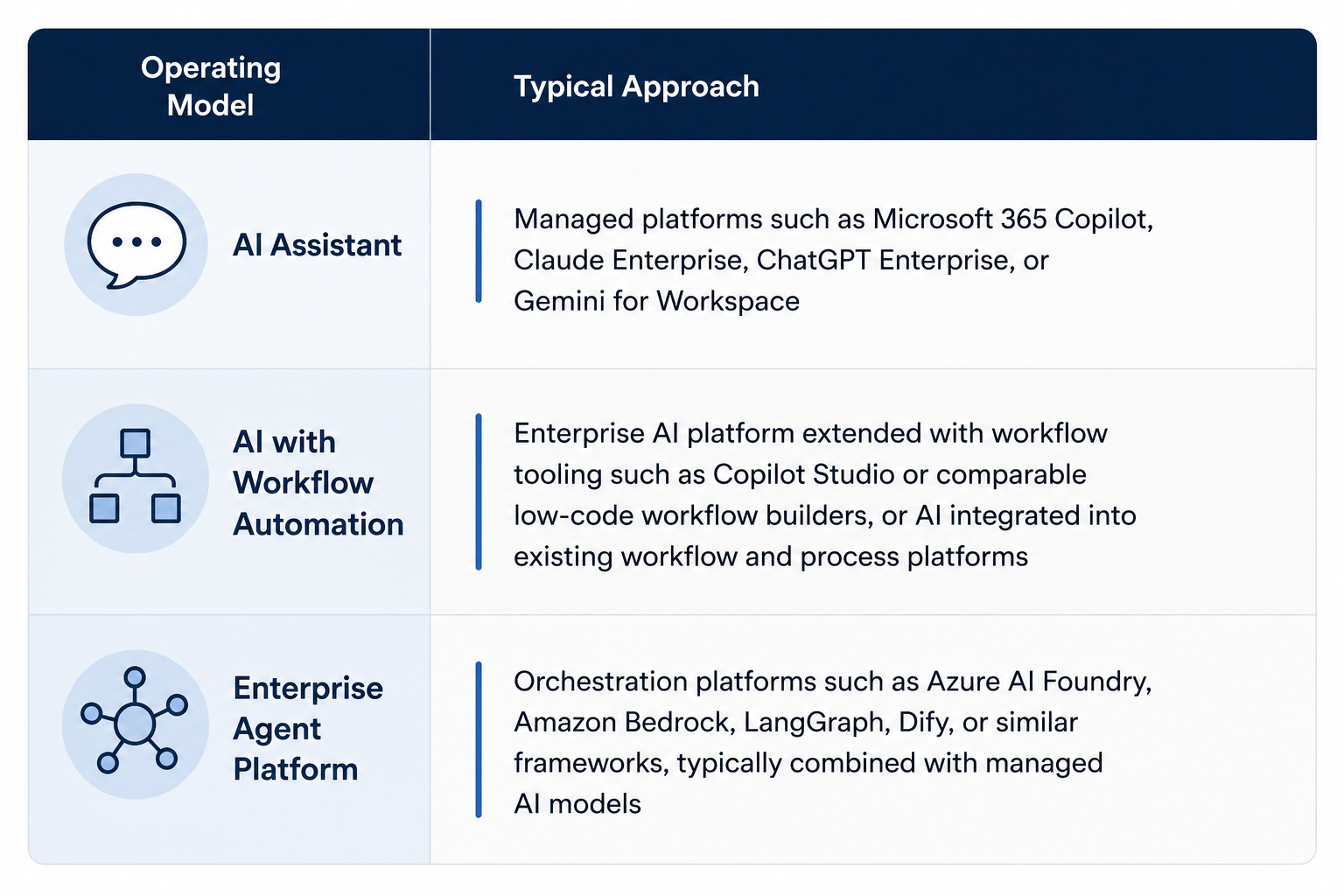
The build versus buy dimension. Within the agent platform model in particular, organisations face a further choice between purchasing a vendor-managed agentic platform, building on top of foundation model infrastructure layers, or adopting a hybrid approach.
For AI Assistant and Workflow AI deployments, many organisations purchase a managed platform. The vendor provides the AI capability, the infrastructure, and typically a degree of implementation support.
For Agent Platform deployments, the picture is more varied. Some organisations purchase managed agentic platforms. Others build on top of infrastructure layers such as Azure AI Foundry or Amazon Bedrock, using orchestration frameworks to assemble their own agent architecture. This approach offers greater flexibility and control at the cost of greater engineering and operational responsibility. Hybrid approaches (where managed platforms cover productivity use cases and a custom build layer handles more complex or proprietary automation) are also common in larger organisations.
The choice between these approaches affects total cost of ownership, architectural flexibility, vendor dependency, and the internal capability the organisation carries to sustain the deployment over time.
Typical Relative Contribution to Total Cost
The table below illustrates relative cost intensity across the three operating models. These are relative indicators rather than absolute values. Actual cost distribution varies significantly by organisation, use case, vendor, and deployment scale.
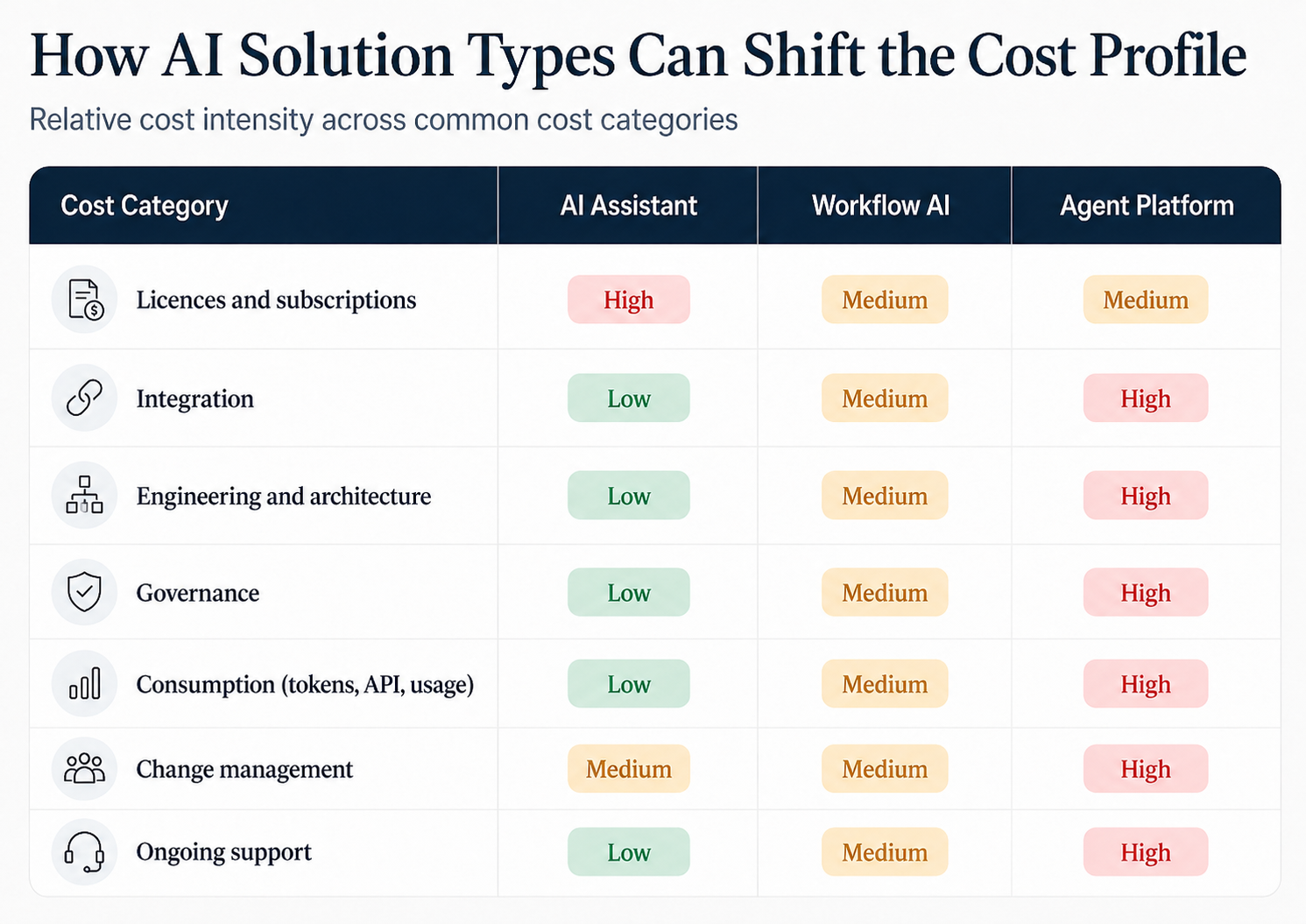
A pattern visible across this table is that licence costs, while significant in the assistant model, tend to become a proportionally smaller component of total cost as operating model complexity increases. Integration, engineering, governance, and operational support can grow materially as organisations move from assistant to workflow to agent models.
The Licence May Not Be the Largest Cost Component
One of the more commonly observed disconnects in enterprise AI procurement is that the procurement decision is driven by licence cost comparison, while the total cost of the programme is driven by operating model selection.
This is not a failure of procurement practice in isolation. Licence costs are visible, comparable, and familiar. Operating model costs are less visible at procurement stage, harder to estimate, and often emerge as the programme develops scope.
As organisations move beyond assistant deployments into workflow automation and agent platforms, orchestration infrastructure, integration development, governance functions, monitoring tooling, and ongoing operational support can become cost items of comparable or greater scale than the underlying licence. The AI platform licence that dominated the initial procurement discussion may represent a minority of total programme cost by the time the deployment reaches operational maturity.
This is not a universal pattern. Some organisations deploy workflow and agent capabilities at relatively contained cost. The risk is highest for organisations that benchmark total AI operating cost solely against licence pricing, without accounting for the operating model they are committing to build.
The Question That Changes the Procurement Conversation
The most useful enterprise AI procurement question is often not which platform is cheapest but which operating model the organisation is trying to build.
Different operating models produce different cost structures, governance requirements, implementation challenges, and commercial considerations. An organisation building toward an agent platform is making different commitments (commercially, architecturally, and operationally) than an organisation deploying a staff productivity assistant, even if both begin with the same platform licence.
Organisations that identify their target operating model before entering vendor evaluation are generally better placed to assess total cost of ownership, understand governance requirements, and frame implementation commitments realistically. Organisations that evaluate AI platforms based primarily on per-seat licence costs may find that the procurement decision made does not accurately reflect the programme subsequently delivered.
This article provides general commercial and procurement commentary only and does not constitute legal, financial, or professional advice.