
Enterprise AI Use Case Definition: Separating Genuine Workflows from Demo-Driven Theatre
Most enterprise AI procurement processes start with a use case that is not really a use case. This guide covers the five attributes of a genuine use case, the four tests that qualify candidates, and the patterns that produce bad ones.
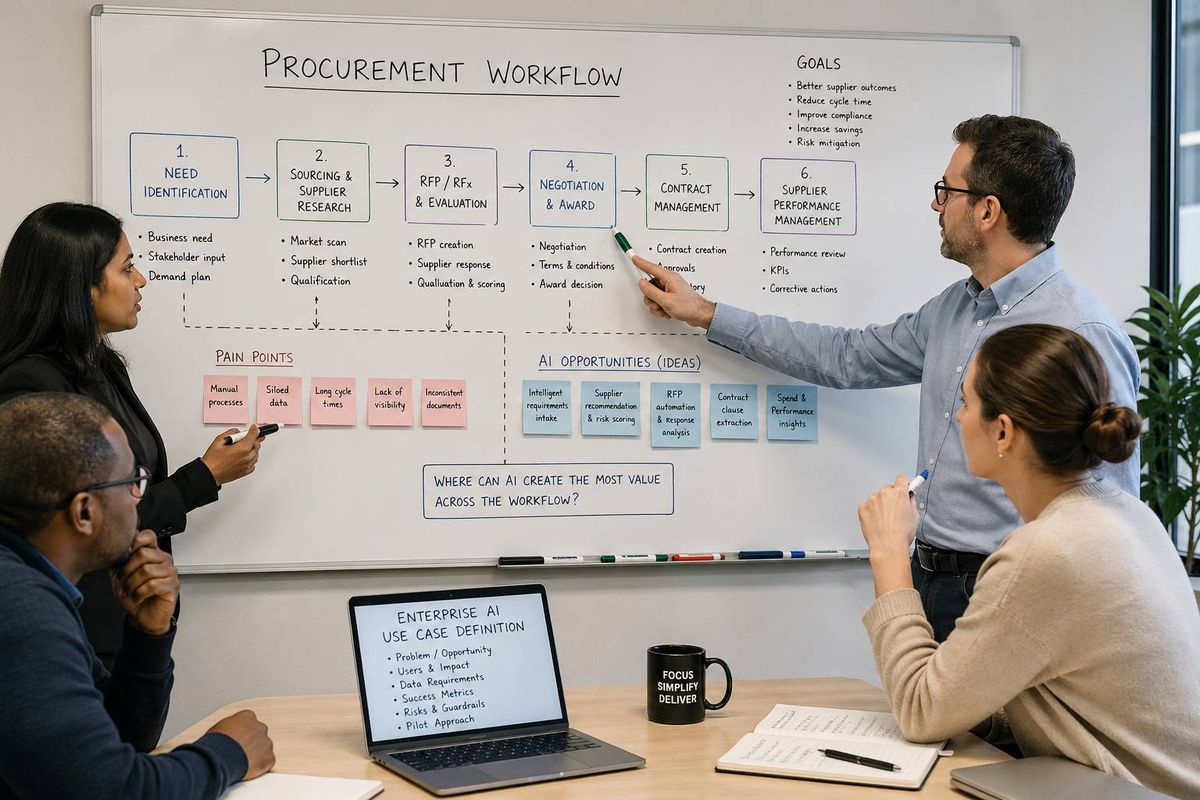
Most enterprise AI procurement processes start with a use case that is not really a use case. It is a sentiment, a workshop output, or a description of a vendor demo that someone in the room found impressive. By the time procurement, IT, and finance get involved, the conversation has already drifted from "what work needs to be done differently" to "what can this platform do." That drift is one of the most consistently expensive patterns in early-stage enterprise AI procurement, and it is largely avoidable.
This article covers what a well-defined use case looks like, how to qualify candidates before vendors enter the conversation, and the patterns that produce use cases that look strong in a slide deck but collapse under operational scrutiny. It sits inside the broader work of enterprise AI procurement before vendor evaluation, and it commonly precedes the downstream work of scoring, NFRs, business case, contracts, and change management.
Why Use Case Definition Is the Highest-Leverage Pre-Procurement Activity
A poorly defined use case tends to fail regardless of vendor quality. A well-defined use case can succeed with several different vendors. This asymmetry is why use case definition deserves more time than most organisations give it.
The cost of getting this wrong compounds. A vague use case produces a vague RFP, which produces vendor responses that cannot be compared like for like. It produces a pilot that cannot prove or disprove value because there is no agreed measure of value. It produces a business case that finance will not approve because the inputs are guesses. And it produces a deployment that adoption teams cannot drive because nobody can articulate what people are supposed to be doing differently.
Vendor demos make this worse. A skilled enterprise AI sales engineer will show capability against a synthetic problem that the platform handles cleanly. The room nods. Someone says "we could use this for X." X then becomes the use case. X was never qualified. X was reverse-engineered from a feature.
The discipline this article describes is the discipline of refusing to do that.
What a Genuine Use Case Looks Like
A genuine enterprise AI use case has five attributes. These are not aspirational. If a candidate use case cannot be described against all five, it is not yet ready for procurement.
A specific workflow, not a domain. "Customer service" is not a use case. "Drafting first-response emails to inbound complaint tickets in a specific queue" is. The unit of analysis is the work, not the function. If the description fits in a job family rather than a workstream, it is too broad.
A defined input and output. What goes in (a customer email, a contract clause, a meeting transcript, a structured data extract) and what comes out (a draft, a classification, a summary, a recommendation). If the input or the output is fuzzy, the system cannot be evaluated and the people doing the work cannot tell whether the output is right.
A measurable current-state baseline. How long does the work take today, what does it cost, how often is it done, what is the error rate, what is the user experience. Without a baseline, "improvement" is just narrative. The baseline is typically quantified before vendor engagement, not after.
A defined success target. What specific change in the baseline would justify proceeding to enterprise procurement. This is not a sales pitch number. It is the threshold below which the investment lacks clear justification. The target is most useful when set by the function that owns the workflow and validated by finance before any vendor sees an RFP.
A clear owner. Not a steering committee. A named role that owns the workflow today, will own it after deployment, and is accountable for whether the use case delivers value. If ownership is contested or shared across functions, the use case is not ready. Ownership ambiguity commonly surfaces during deployment and tends to stall adoption.
A use case that has all five attributes can be RFP'd, piloted, costed, and governed. A use case missing any of them cannot.
One consideration that sits alongside these attributes rather than replacing them: even technically sound use cases can fail to deliver value if users are unwilling or unable to incorporate the output into their existing workflow. Use cases where AI assistance fits naturally into an established process, and where users can meaningfully verify the output, tend to see stronger adoption than those that require users to trust and act on unfamiliar AI-generated outputs without a clear way to check them. This is not a disqualifying factor on its own, but it is a signal worth examining early. The change management work that follows deployment is harder to recover from when the workflow fit was not examined during use case definition.
Qualifying Candidate Use Cases: The Four Tests
Once candidates exist, qualification is typically the next step. Most organisations skip this step and go straight from "we have a list" to "let's invite vendors." The result is a procurement process that wastes effort on use cases that will not survive operational reality.
The four tests below screen out the candidates that look attractive in a workshop but fail under scrutiny.
Test 1: Is the Data Actually Available?
Enterprise AI is data-bound. If the data the system needs is fragmented across systems with different ownership, inconsistently formatted, poorly documented, or subject to access restrictions that have not been resolved, the use case commonly encounters integration failure regardless of vendor quality.
Before a use case proceeds, document where the data lives, who owns it, what state it is in, and what work is required to make it accessible. If the answer is "we will sort that out during implementation," the use case is not qualified. Data access is a precondition, not an implementation task.
Connector readiness and data access permissions are covered in the pre-evaluation framework as gating considerations.
Test 2: Is the Decision Logic Codifiable?
Enterprise AI executes decisions at scale. It cannot apply judgment that has not been articulated. If the workflow relies heavily on tacit knowledge held by experienced staff, on informal escalation patterns, or on context that is rarely documented, the system commonly produces outputs that are less reliable than they appear.
The qualifying question is not "do we have rules" but "could we write the rules down well enough that someone new could apply them." If the answer is no, the use case needs decision logic work before it can proceed. This is sometimes called codification, and it is unglamorous but unavoidable.
A use case where the rules are clear, exceptions are documented, and edge cases have known handling is a strong candidate. A use case where everything depends on "Sarah knows how this works" is not.
Test 3: Is the Output Verifiable?
Some AI outputs are easy to check. A document classification is right or wrong. A drafted email is good enough or not. A code snippet runs or it does not.
Other outputs are not verifiable in any practical sense. A "strategic recommendation" generated by a model is unfalsifiable. A "synthesis of customer sentiment" cannot be audited at scale. If the output cannot be checked by the person receiving it, the system cannot be governed and errors cannot be caught.
Verifiable does not mean automated. Human review is fine, often essential. What matters is that someone can tell, in reasonable time, whether the output is fit for purpose. Where verification is operationally impractical or prohibitively expensive, the use case is commonly not ready to proceed.
Test 4: Does the Volume Justify the Investment?
Enterprise AI carries fixed costs that do not scale down. Implementation, integration, governance, training, change management. These costs are largely the same whether the use case runs ten times a day or ten thousand.
A use case with high per-instance value but low volume often looks attractive and is not. A use case with modest per-instance value and high volume is usually where enterprise AI earns its keep.
The qualifying question is whether the projected volume, multiplied by the projected per-instance value, exceeds the realistic total cost of ownership across the relevant time horizon. This question is best answered with the total cost of ownership work covered in enterprise AI pricing vs total cost of ownership, and this analysis is most useful when completed before vendor engagement, not after.
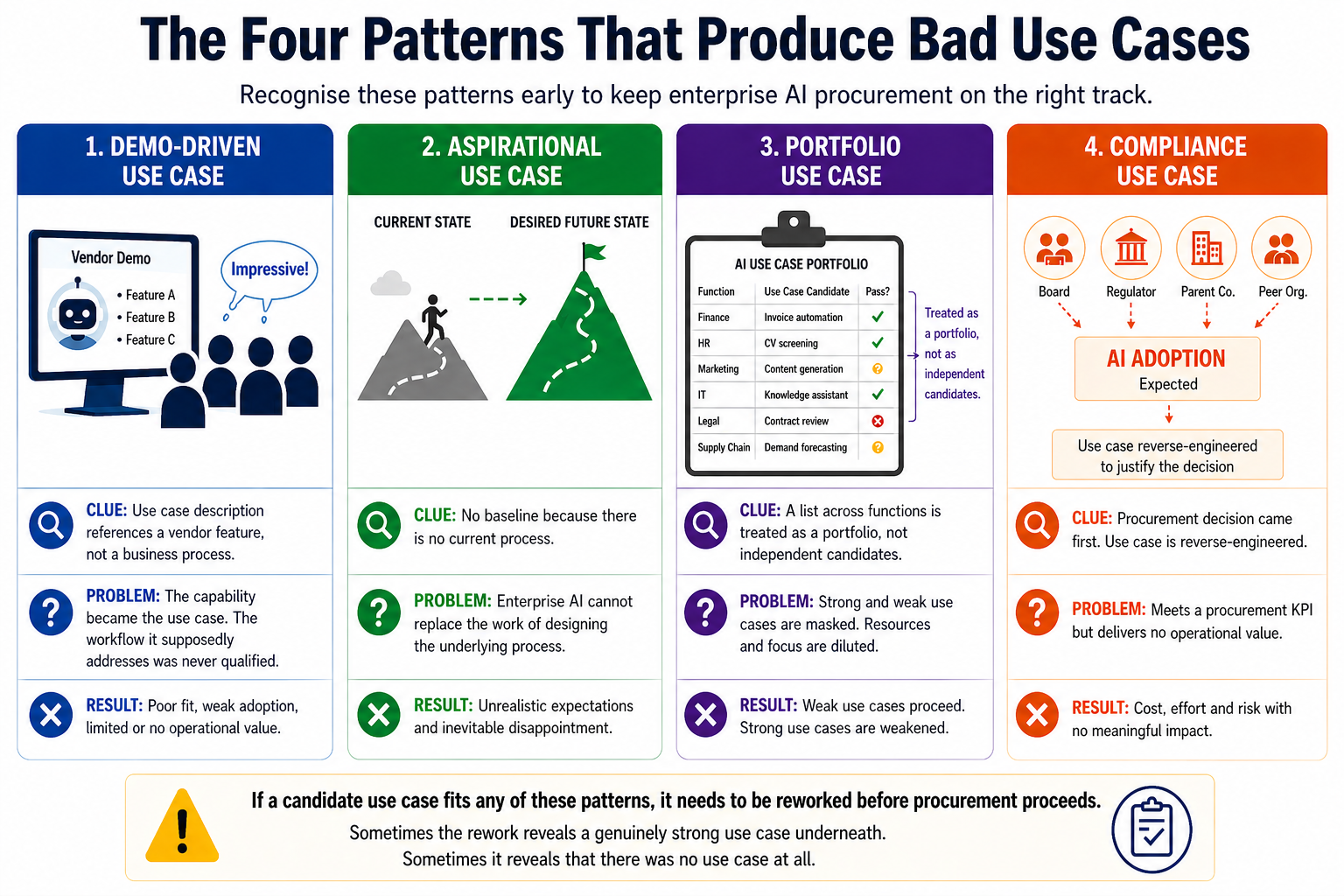
The Four Patterns That Produce Bad Use Cases
Across enterprise AI procurement work, the same patterns recur. Recognising them early saves the procurement process from drifting into a bad outcome.
The demo-driven use case. A vendor showed a capability. The room found it impressive. The capability became the use case. The workflow it supposedly addresses was never qualified. The clue is that the use case description references a vendor feature rather than a business process.
The aspirational use case. Someone wants AI to do something the organisation does not currently do well. The use case is framed as the desired future state, not as a defined improvement to current state. There is no baseline because there is no current process. Enterprise AI cannot replace the work of designing the underlying process.
The portfolio use case. Leadership has decided AI must be deployed across multiple functions. A list is generated, often in a workshop, of candidates from each function. The list is treated as a portfolio rather than a set of independent candidates that must each pass qualification. Some will be strong. Some will not. Treating them as a portfolio masks the difference and weakens the strong ones.
The compliance use case. AI is procured because the board, the regulator, the parent company, or a peer organisation has signalled that AI adoption is expected. The use case is reverse-engineered from the procurement decision rather than the procurement decision being driven by the use case. This produces deployments that meet a procurement KPI and deliver no operational value.
Candidate use cases that fit any of these patterns commonly warrant rework before procurement proceeds. Sometimes the rework reveals a genuinely strong use case underneath. Sometimes it reveals that there was no use case at all.
Use Case Definition and the Build vs Buy Question
Use case definition is also the input that makes enterprise AI build vs buy decisions answerable. The same use case can be a clear "buy" or a clear "build" depending on its specifics.
A use case that is generic, well-served by existing platforms, and not a source of competitive differentiation for the organisation commonly leans buy. A use case that is highly specific to the organisation's operations, depends on proprietary data and decision logic, and represents a source of competitive differentiation commonly leans toward build or blend.
Without a defined use case, the build vs buy question is unanswerable in any meaningful way. Procurement teams who ask the question early, before use case definition, end up with vendor-led answers, because vendors will typically say buy.
What Procurement Should Do With a Defined Use Case
A use case that has passed qualification becomes the basis for several downstream procurement artefacts.
It defines the functional requirements of the RFP, ensuring vendor responses describe how they would address a real workflow, not their generic platform capability. It anchors the enterprise AI vendor evaluation scorecard, so that scoring reflects fit to the workflow rather than feature inventory. It sets the success criteria for any pilot, ensuring the pilot actually tests the use case rather than serving as an extended demo. It feeds the business case with quantified inputs, so that finance is approving a number rather than a hope. And it gives change management something to point at, because the workflow is described in operational terms rather than abstract capability terms.
Each downstream activity is stronger if the use case definition is strong. Each is weaker if it is not. There is no recovering this work later.
A Note on Sequencing
Use case definition belongs at the very beginning of enterprise AI procurement. It precedes vendor shortlisting, RFP issuance, and architecture decisions. It is best done by the function that owns the workflow, supported by procurement and IT, with finance involved early enough to validate the baseline and the target.
The temptation to compress this stage is strong. Boards want movement. Vendors want engagement. Internal sponsors want visible progress. Compressing use case definition usually does not save time, because the work that gets skipped surfaces later as scope changes, integration surprises, and adoption stalls. The time spent on definition is paid back several times over during the rest of the procurement.
If use case definition feels slow, the alternative is not faster. The alternative is procurement that is moving quickly toward a less defensible outcome.
This article provides general commercial and procurement commentary only and does not constitute legal, financial, or professional advice.