
Enterprise AI Procurement: Where to Start
If You've Been Asked to "Do Something With AI", you are not alone. Organisations across every sector are being told to adopt AI, evaluate AI tools, or develop an AI strategy. Board members are asking questions. Executives are setting targets. Industry peers are announcing initiatives.
Most leaders tasked with this were not trained for it. Enterprise AI procurement is not part of standard IT buying processes, commercial frameworks, or governance playbooks. The landscape changes rapidly. Vendor messaging is confusing. The stakes feel high.
If you feel uncertain about how to approach this, that uncertainty is appropriate. Enterprise AI procurement is genuinely different from what came before. This guide provides clear orientation on what enterprise AI procurement actually involves and what decisions matter most at the beginning.
What Enterprise AI Actually Means (In Plain Terms)
Enterprise AI refers to artificial intelligence systems embedded into your organisation's workflows and operations. This is distinct from individual employees experimenting with consumer AI tools or running isolated pilots.
When AI becomes enterprise infrastructure, it processes your internal data, makes decisions that affect customers or operations, and creates dependencies across business functions. It typically involves contracts with vendors who provide AI models, platforms, or services that your organisation relies on consistently.
Understanding the vendor landscape: You can procure enterprise AI in two main ways. Direct procurement from large language model providers - such as ChatGPT Enterprise (OpenAI), Claude for Enterprise (Anthropic), or Gemini for Business (Google) - gives you access to a single vendor's models and platform. Alternatively, aggregator platforms like Perplexity or orchestration layers provide access to multiple LLM providers through a single interface, allowing you to use different models for different tasks or switch between providers as capabilities evolve.
This architectural choice has significant implications. Direct vendor relationships may offer deeper integration and support but create dependency on that vendor's roadmap and pricing. Aggregator platforms provide flexibility to adapt as the market changes - important in a landscape where new model releases can shift competitive positioning rapidly - but add a layer of abstraction and potential complexity.
Enterprise AI is not a one-time software purchase. Beyond the license fees, it requires implementation work, system integration, ongoing support, and operational management. As more departments adopt AI or as use cases expand, the total investment grows through additional licenses, expanded integrations, and increased support requirements.
This creates three realities that make enterprise AI procurement different from buying standard software: costs that extend well beyond the license, data handling that extends to every user interaction, and architectural decisions that determine long-term flexibility. Understanding these realities helps you avoid the most common procurement failures.
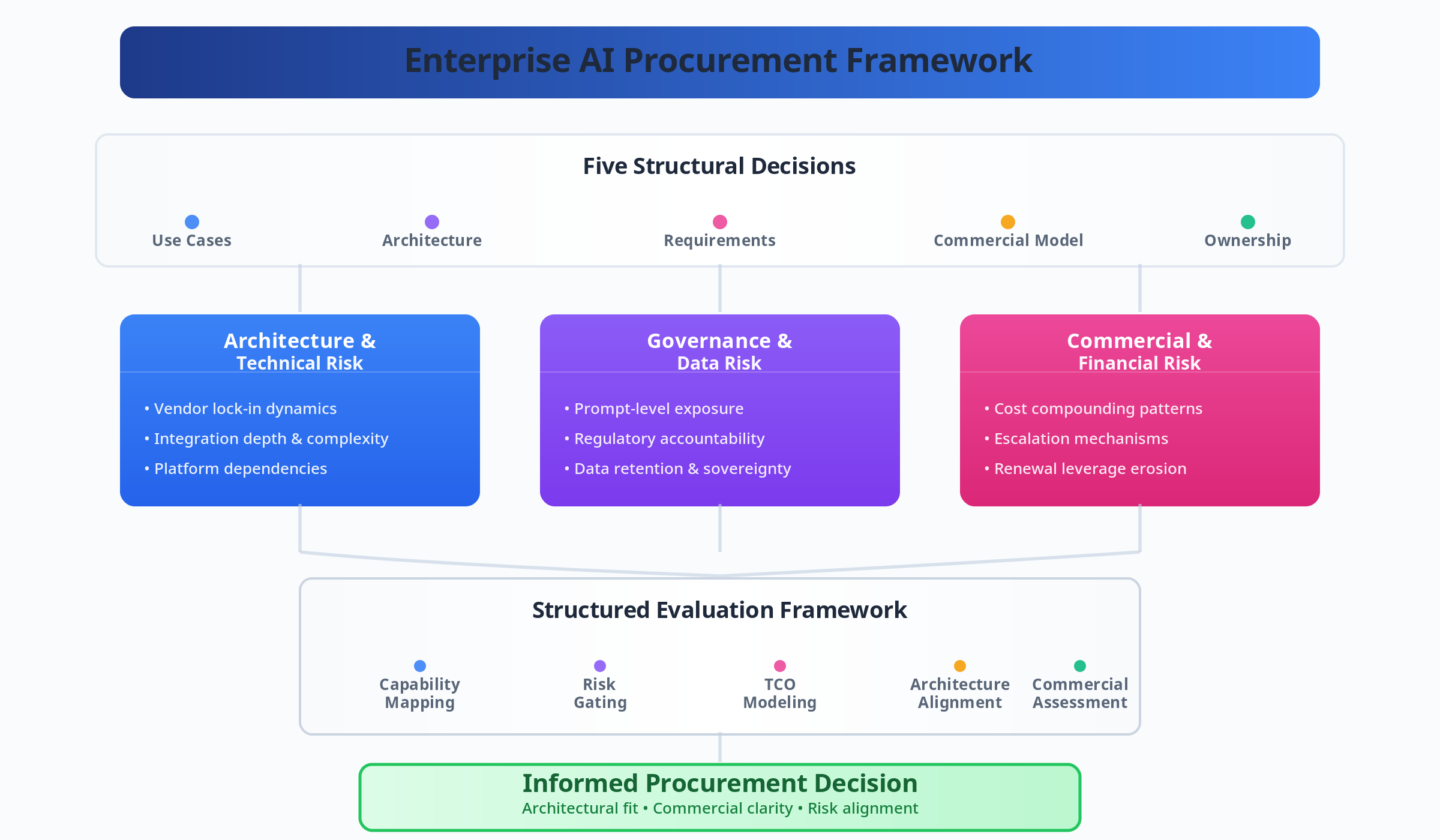
Enterprise AI Procurement Framework
Why This Is Different from Buying Normal Software
Costs Extend Beyond the License
Traditional software often has straightforward pricing. You buy licenses for a known number of users and pay a fixed subscription. Enterprise AI pricing appears similar on the surface, but the total cost extends significantly beyond the vendor's license fee.
Implementation costs can be substantial. Integrating AI into existing workflows requires technical development, testing, and deployment work. Connecting AI systems to your data sources, applications, and business processes often requires custom integration work that vendors do not include in quoted pricing.
Support and maintenance costs accumulate over time. Enterprise AI systems require ongoing management, user support, troubleshooting, and updates. These operational costs are separate from license fees and can represent significant ongoing investment.
As more departments adopt AI or as your organisation expands its use cases, you may need additional licenses, expanded integrations, or enhanced support structures. The initial license cost rarely reflects the total investment required to make enterprise AI functional and sustainable within your organisation.
Every Prompt Can Contain Sensitive Information
When someone uses enterprise AI, they interact through prompts - questions, instructions, or requests typed into the system. Each prompt can contain confidential information, customer data, intellectual property, or personal details, even when users do not intend to share sensitive content.
Standard security controls focus on system access and network protection. Enterprise AI requires controls at the interaction level. You need to manage what information users can submit, how vendors store and process that information, and whether prompts are retained, logged, or used for other purposes. This is data exposure at a scale and granularity that conventional governance frameworks were not designed to handle.
Architectural Decisions Create Long-Term Dependency
When you adopt enterprise AI, you are not just licensing software. You are making architectural choices about how AI integrates with your existing systems, where data is processed, and which vendor platforms become embedded in your operations.
These decisions create switching costs. If you later want to change vendors, you may need to re-engineer integrations, migrate data, retrain users, or rebuild workflows. The deeper the integration, the higher the cost of changing direction. Vendor lock-in is not just contractual - it is technical and operational.
This matters particularly in enterprise AI because the market evolves rapidly. A vendor leading the market today may be surpassed by a competitor's new model release in six months. If your architecture tightly couples your operations to a single LLM provider, adapting to market shifts becomes expensive and disruptive. This is why some organisations choose aggregator platforms or build abstraction layers that preserve the ability to switch providers or use multiple models simultaneously - accepting some additional complexity today to maintain flexibility as the competitive landscape changes.
The Five Big Things You Must Decide First
Be Clear About the Problem You're Solving
Many organisations begin enterprise AI procurement with vague objectives: "improve productivity," "innovate with AI," or "stay competitive." These goals do not provide enough structure to evaluate vendors or make architectural decisions.
You need specific use cases tied to measurable outcomes. Which business process will AI support? What problem does it solve that current tools do not? What does success look like? Without this clarity, you will struggle to assess whether a vendor's capabilities actually fit your needs, and you will have no way to determine whether the investment delivered value.
Generic AI ambitions lead to vendor-led decision-making, where sales teams shape your strategy around their product roadmaps rather than your organisational requirements.
Enterprise AI Requires Decision Clarity
Enterprise AI systems execute decisions at scale. They rely on patterns, rules, and context to determine appropriate actions or responses. If those patterns and rules are not clearly documented, AI amplifies whatever inconsistency exists in your current processes. The system cannot apply judgment that has not been codified.
Most organisations operate on a foundation of unwritten rules and institutional knowledge. Experienced employees know how to handle exceptions, when to escalate, which approvals are genuinely required, and when informal resolution is appropriate. This knowledge lives in individuals, not in systems. It works because people apply context and judgment. AI systems cannot access that implicit knowledge.
Before enterprise AI can reliably scale decisions across your organisation, you must clarify how those decisions are actually made. This means codifying approval logic that may currently exist only in people's heads, defining how exceptions should be handled rather than relying on individual judgment, documenting governance principles that guide edge cases, and clarifying ownership boundaries between functions or roles. AI performs well when operating within clear frameworks. It performs unpredictably when frameworks are ambiguous.
This requirement affects both vendor evaluation and architectural choices. Vendors differ in how they support decision logic, rule definition, and exception handling. Your architecture must accommodate the governance structures you define. Enterprise AI procurement is not just tool selection. It is an exercise in organisational self-definition that happens to involve AI technology.
Understand How Costs Grow Over Time
Enterprise AI costs extend well beyond the vendor's initial license quote. Implementation costs - integrating AI with your systems, connecting data sources, and configuring workflows - often exceed the first year's licensing fees. These are typically separate from the vendor contract and difficult to estimate accurately at the beginning.
As adoption expands across departments, you face additional license purchases, more complex integrations, and increased support requirements. Each new use case may require separate implementation work. Connecting AI to different systems or data sources creates incremental integration costs.
Before committing to a vendor, understand the full cost structure: licenses, implementation services, ongoing support, integration development, infrastructure requirements if any, and the internal staff time needed to manage the system. Many organisations discover that the vendor's quoted price may not accurately represent total first-year costs once implementation and integration are included.
Define Governance Before Vendor Selection
Governance determines what controls must be in place before AI can process organisational data. This includes defining what types of information can be submitted to AI systems, how vendors handle and retain that data, who has access, and what audit mechanisms exist.
If you define governance requirements after selecting a vendor, you may discover that the vendor's data handling practices do not align with your compliance obligations or risk tolerance. Retrofitting governance controls is difficult and often incomplete.
Establish basic governance parameters first: what data sensitivity levels are acceptable, what regulatory requirements apply, what retention policies you need, and what security standards vendors must meet. These become gates during vendor evaluation, not negotiation points after contracts are signed.
Decide on Single-Vendor or Multi-Model Access
Before evaluating specific solutions, determine whether you will commit to a single LLM provider or maintain flexibility through aggregator platforms that provide access to multiple providers.
Single-vendor enterprise plans (ChatGPT, Claude, Gemini) offer direct relationships with model providers, typically with comprehensive support and integration capabilities. However, they create dependency on that vendor's pricing and development roadmap. In a market where competitive positioning shifts rapidly with each major model release, being locked into a single provider carries risk.
Aggregator platforms or orchestration layers let you access multiple LLM providers through a unified interface. This preserves your ability to use different models for different tasks, or to switch providers as capabilities evolve. The trade-off is additional vendor complexity and potentially limited access to provider-specific features.
This decision affects your exposure to market volatility, influences long-term costs, and determines how easily you can adapt as the enterprise AI landscape continues to evolve.
What Usually Goes Wrong
Buying Before Defining Use Cases: Organisations sign enterprise agreements based on optimistic assumptions about how AI will be used, then struggle to justify the investment when actual use cases remain unclear. Without defined use cases, you cannot validate whether AI delivers value or whether you have chosen the right vendor.
Signing Enterprise Agreements Too Early: Vendors offer enterprise licensing with volume discounts and multi-year commitments. These agreements lock in costs before you understand actual demand. If adoption is slower than projected, you pay for unused capacity. If adoption accelerates differently than expected, the agreement may not cover your actual usage patterns.
Ignoring Data Exposure: Teams focus on functionality - what the AI can do - without adequately addressing what data it will process. Prompts submitted to AI systems often contain confidential information that users do not recognize as sensitive. Governance controls implemented after deployment are less effective than controls designed into procurement decisions.
Letting Vendors Define Architecture: Vendor demonstrations and proof of concepts can guide your architectural decisions in directions that serve vendor business models rather than your long-term flexibility. Once you commit to a vendor's specific deployment model, integration approach, or platform dependencies, changing direction becomes expensive. This is particularly risky in enterprise AI where today's market leader may be overtaken by a competitor's breakthrough in months, leaving you locked into an inferior solution.
Fragmented Ownership: Enterprise AI spans IT, procurement, legal, security, compliance, and business units. Without clear ownership of vendor relationships, usage governance, cost management, and risk oversight, accountability fragments. Decisions get made in silos, risks accumulate, and no single function has visibility into total exposure.
If You Want to Go Deeper
Enterprise AI procurement becomes more complex once you move beyond initial orientation. The resources below provide structured guidance for organisations ready to develop detailed evaluation frameworks and governance structures.
Enterprise AI Procurement Framework
Comprehensive methodology covering architectural decisions, vendor evaluation stages, commercial modeling, governance gating, and total cost of ownership analysis. Read the enterprise AI procurement framework.
Enterprise AI Vendor Evaluation Preparation
Structured guidance for defining use cases, assessing internal readiness, mapping data and integration requirements, and establishing evaluation criteria before vendor engagement begins. Read the vendor evaluation preparation guide.
Enterprise AI Commercial Risk Analysis
Detailed examination of pricing structures, contract terms, usage forecasting, escalation mechanisms, and financial modelling across realistic adoption scenarios. Read the enterprise AI commercial risk analysis.
Enterprise AI Governance Guide
Implementation guidance for policy development, technical controls, prompt-level security, data handling requirements, and regulatory compliance structures. Read the Enterprise AI governance guide
Advisory Support
Hands-on support for use case definition, vendor evaluation, governance design, and structured procurement implementation. Learn about advisory services.
Tools and Resources
Enterprise AI procurement involves more moving parts than most technology investments. The tools and resources below are free for members and provide structured starting points for readiness assessment, vendor evaluation, governance design, and total cost of ownership modelling. They are intended to support internal thinking and planning, not to substitute for qualified legal, financial, or technical advice specific to your organisation's circumstances.
Enterprise AI Readiness Assessment
Validate your organisation's readiness before engaging vendors. A structured diagnostic across five domains. Access the assessment.
Enterprise AI Vendor Evaluation Scorecard
Interactive six-dimension weighted scoring tool for comparing shortlisted vendors objectively. Produces a ranked, defensible selection recommendation. Access the scorecard.
Enterprise AI TCO Calculator (coming soon)
Model your true total cost of ownership across licence, implementation, integration, governance, and operational cost categories.
Enterprise AI Governance RACI (coming soon)
Interactive RACI matrix covering the full AI governance lifecycle — from strategy and use case approval through to vendor selection, contracting, deployment, and ongoing operations. Filter by role or domain.
Contract Terms Checklist (coming soon)
A structured checklist of the commercial and legal provisions that require clarity before signing an enterprise AI contract. Covers data handling, model updates, liability, termination, and SLA commitments.
Business Case Builder (coming soon)
Structured template for building a defensible internal business case for enterprise AI investment, covering use case definition, cost modelling, risk assessment, and governance readiness.
This assessment is provided for informational purposes only and does not constitute legal, financial, or professional advice. Organisations should independently validate vendor capabilities, contractual terms, and regulatory obligations relevant to their specific circumstances.