
How to Measure AI ROI: From Time Saved to Financial Value
Hours saved are not automatically ROI. A practical framework for tracing AI productivity through released capacity, operational outcomes and financial value.

AI business cases often turn productivity gains into financial value using a simple calculation: time saved multiplied by labour cost. The logic looks compelling.
Take a 500-person organisation where AI saves each employee ten minutes per working day. Across 220 working days, that adds up to 18,333 hours a year. At a loaded labour cost of $70 an hour, the model produces a $1.28 million benefit. Against a $400,000 annual platform cost, that suggests an $880,000 net benefit and a 220% return.
The figures are illustrative, but the problem they expose is straightforward. Where does the $1.28 million actually appear?
Payroll has not fallen. Headcount has not changed. Contractor spend is unchanged. Revenue has not moved. Employees may genuinely be working faster, but nobody in finance can point to where the $1.28 million landed.
The maths is not the problem. The classification is. Monetised time saved is being presented as though it were a cash saving, when those are two different things.
This article is written for procurement leaders, finance teams, AI commercial leads, and CIOs building or reviewing the ROI case for an enterprise AI investment. It sets out why hours saved is not, by itself, evidence of financial return, and offers a framework for following productivity through to the economic outcome a CFO can defend.
AI Productivity Is Real. The Financial Translation Is Not Automatic
None of this is an argument against AI productivity gains. There is credible evidence that generative AI can improve productivity in some workflows when deployed effectively.
A study of 5,179 customer support agents, using data from a Fortune 500 enterprise software company, published by Erik Brynjolfsson, Danielle Li and Lindsey Raymond, found that access to a generative AI assistant increased issues resolved per hour by 14% on average, with larger gains among less experienced workers. A separate field experiment involving 7,137 knowledge workers across 66 firms, led by Eleanor Dillon and colleagues, found that workers who actively used an integrated generative AI tool spent around two fewer hours per week on email by the second half of a six-month trial, without a detectable broader shift in the tasks those workers were doing.
Time was saved. What replaced it was harder to observe. The question is no longer really whether AI can save time; there is now credible evidence that it can, in the right workflow. The commercial question is what happens to that time afterwards, and that is where most business cases stop asking.
Why Hours Times Salary Is Not Automatically ROI
The hours-times-salary calculation is popular for good reason. It is simple, quantifiable, and converts something soft, like productivity, into something that looks financial and slots neatly into a board paper.
It also carries a hidden assumption: that one hour saved equals one hour of labour cost removed. That assumption often does not hold, particularly for salaried knowledge work. If an employee earning $140,000 saves four hours a week, the organisation has not saved 10% of that salary. Nobody is paid less, nobody has left, and what has actually been created is additional capacity whose value depends entirely on what happens to it next.
The distinction is not that time savings are worthless unless headcount falls; many of the most defensible AI benefits do not touch headcount at all. The distinction is between reporting capacity as though it were a cash saving, and reporting it as what it is: a resource freed up, with its value still to be determined.
Public sector appraisal guidance draws a version of this line, applied here as an analogy rather than an accounting standard. UK Treasury Green Book guidance distinguishes cash-releasing benefits, which affect an organisation's income or expenditure, from non-cash-releasing benefits, while separately recognising higher labour productivity as an economic benefit in its own right. Both can be legitimate. They are not the same category, and a business case that conflates them tends to lose credibility with the people defending it later.
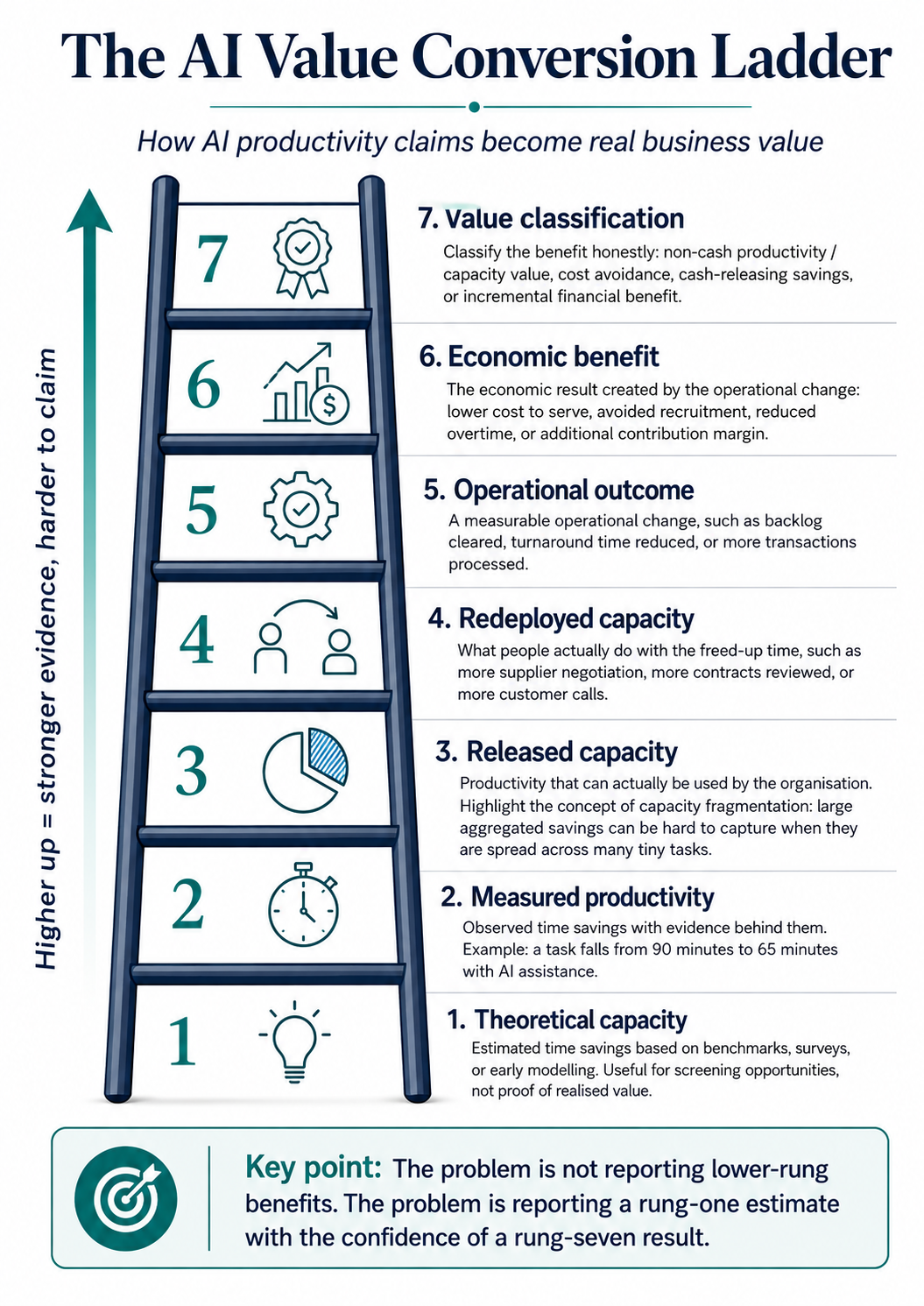
The AI Value Conversion Ladder
One way to make that distinction usable in practice, proposed here as the AI Value Conversion Ladder, is to treat AI-driven productivity as a progression, with the benefit becoming more certain, and harder to claim, at each of seven rungs.
Theoretical capacity. What could AI save, based on vendor benchmarks, employee surveys, or early use-case modelling? A claim that a platform could save twenty minutes a day belongs here. It is useful for screening opportunities, not evidence of anything realised.
Measured productivity. What did AI actually save, observed rather than estimated? Where comparable contract reviews show a baseline of 90 minutes and an AI-assisted duration of 65 minutes, that is evidence of a 25-minute improvement, the point where a claim starts to have evidence behind it rather than an assumption.
Released capacity. How much of that measured productivity is capacity an organisation can practically use? This is where capacity fragmentation becomes the operative concept. Thirty minutes recovered from one recurring three-hour process is far more commercially usable than two minutes recovered across fifteen unrelated activities. Small gains, dispersed across thousands of tasks, can look enormous once aggregated in a spreadsheet while being genuinely difficult to capture in practice.
Redeployed capacity. What did people actually do with the time? More supplier negotiation, more contracts reviewed, more calls made. This is where theoretical productivity becomes an operational choice, not yet a financial one.
Operational outcome. Did something measurable change as a result? Transactions processed, backlog cleared, turnaround time reduced, the bridge between capacity and economics.
Economic benefit. What economic result did that operational change produce? Lower cost to serve, avoided recruitment, reduced overtime, additional contribution margin.
Value classification. What has actually been created, classified honestly rather than defaulted to cash? Four categories tend to cover most cases: non-cash productivity or capacity value, where existing staff absorb more work but nothing is banked; cost avoidance, where planned employee hires no longer happen; cash-releasing saving, where contractor or licence spend is removed; and incremental financial benefit, where additional revenue exceeds the cost of serving it.
Reaching the top rung is not a precondition for a benefit being worth reporting. A benefit sitting at rung four can still be genuinely useful information for a management team. The problem is reporting a rung-one estimate with the confidence of a rung-seven result. The further a benefit has travelled up the ladder, the stronger the evidence behind the number attached to it.
Reapplying the Ladder to the $1.28 Million Case
Return to the opening illustrative scenario, this time following the ladder instead of skipping to the total.
Theoretical capacity, based on the initial assumption, sat at 18,333 hours. Assume a pilot measuring actual task time puts realised productivity closer to 14,500 hours. Once capacity fragmentation was accounted for, roughly 10,000 of those hours were practically releasable, concentrated in recurring, higher-volume tasks rather than spread evenly across the workforce, and around 8,000 hours were genuinely redeployed: most absorbed a workload increase without additional recruitment, some supported additional customer-facing activity, and roughly 1,000 hours stayed diffuse, spread across tasks with no clear economic pathway attached.
Classified this way, the case lands closer to $280,000 in avoided recruitment and $150,000 in incremental contribution margin, plus roughly 1,000 hours of measured productivity capacity that is left unmonetised because no economic pathway for it has been demonstrated. That is considerably smaller than $1.28 million, and it is a number that survives the question the CFO asked in the opening scenario. The AI may still represent a worthwhile investment; the business case is simply describing its economics accurately rather than optimistically, and leaving a benefit unpriced is preferable to inventing a dollar figure for it.
Replacing the Arbitrary Haircut With a Value Conversion Waterfall
A common response to inflated productivity claims is to apply a discount: a vendor claims $2 million in productivity value, so finance halves it. That produces a more conservative number, not a more defensible one, because the 50% is no less arbitrary than the original claim.
A framework proposed here as a Value Conversion Waterfall offers an alternative: a sequence of conversion factors, each tied to a specific piece of evidence, moving from theoretical hours down to hours with a demonstrated link to an economic outcome. For illustration: 100,000 theoretical hours, of which 70% relate to eligible tasks (70,000), of which 75% show sustained adoption (52,500), of which 60% of forecast productivity is demonstrated in practice (31,500), of which 50% is practically releasable given capacity fragmentation (15,750), of which 40% can be linked to a measurable economic outcome (6,300).
The percentages are illustrative, not standard figures to carry into another model. What matters is the structure: each stage is a placeholder for evidence that can progressively replace the initial estimate, turning a business case from something resembling a vendor's sales calculator into an evidence-based model built up in stages rather than asserted in one line.
Three Questions the Business Case Tends to Face
Business cases that hold up under scrutiny tend to have answered three questions before they reach the investment committee.
Did AI actually improve productivity? The strongest evidence combines a documented baseline, a post-deployment measurement using the same method, and a defined population of eligible tasks. A vendor claim that customers typically save thirty minutes a day is a hypothesis, not evidence.
Can the capacity actually be captured? This is where capacity fragmentation resurfaces. A saving concentrated in one workflow can be redesigned around. A saving scattered across dozens of unrelated micro-tasks tends to be absorbed and disappear without a trace.
What connects capacity to economic value? A credible business case can describe the pathway in a single chain: AI enables faster processing, which absorbs additional workload, which avoids three planned hires, an identifiable, costed outcome. Where that chain cannot be described plainly, the benefit at the end of it is an expectation, not yet a return.
Horizontal Copilots Carry a Harder ROI Problem Than Workflow Agents
Enterprise copilots, the kind that assist with email, meetings, documents, search, and general administration, can generate real productivity value across a large user base. That value is also distributed thinly across many employees and many small tasks, precisely the condition under which capacity fragmentation is hardest to overcome. A defined workflow agent sits at the other end of the spectrum: a process that currently absorbs eight FTE-equivalent workload, redesigned around an agent to operate at five, has a clearer, traceable economic mechanism behind it, because the productivity is concentrated rather than scattered, although the released capacity has yet to be classified.
Neither pattern is inherently the stronger investment. What follows from the contrast is narrower: the broader a productivity tool's reach across an organisation, the harder its financial ROI can often be to demonstrate, even where the underlying operational value is genuine.
Don't Treat Revenue as the AI Benefit
Where AI supports revenue growth, the same discipline applies in a different form. If AI-assisted proposals or customer service contribute to $1 million in additional sales, that figure is not the AI benefit, because additional sales carry additional variable cost: delivery, fulfilment, support. A more defensible figure nets the two out: $1 million in incremental revenue, less $600,000 in incremental variable costs, leaves $400,000 in contribution margin, to the extent that uplift can reasonably be attributed to the AI-enabled change rather than to pricing, territory, or campaign activity running at the same time. Reporting the top-line figure alone tends to overstate the benefit and invites the same scrutiny that unravelled the $1.28 million hours-times-salary case.
Ownership and Cadence: Keeping the Model Honest After Approval
An AI business case built at the point of approval is a snapshot of assumptions that were true, or believed to be true, on a single day. Adoption changes, workflows get redesigned, and model pricing shifts, so the case that secured funding is rarely the case that still describes reality twelve months later.
Australian Government guidance on Commonwealth investment business cases makes a related point in a public sector context: business cases are treated as iterative, updated continually with the best available information on benefits, timelines, and owners, rather than finalised once at approval. A practical cadence could move from initial hypothesis, through pilot data, to a production baseline, a ninety-day review, and a six-month review that informs any renewal or scale decision, comparing forecast against actual at each point.
Responsibility tends to split across roles: the business owner is closest to whether the operational outcome improved, technology holds the evidence of what the system consumed, finance validates how a benefit is classified, and procurement tests vendor claims against pricing and adoption assumptions.
Why This Is Proving Harder Than Deployment Itself
The evidence emerging in 2026 points toward value realisation, not deployment, as the harder problem. PwC's 2026 AI Performance study, based on a global survey of senior executives, found organisations in the top 20% by measured AI-driven financial gains captured close to three-quarters of the economic value identified across the study, generating roughly 7.2 times the AI-driven revenue and efficiency gains of their peers. The leaders in that study were differentiated less by simply deploying more AI and more by how they applied it, with greater emphasis on growth, workflow redesign, and business reinvention rather than labour cost reduction alone.
Deloitte's survey of 1,854 executives across Europe and the Middle East found most respondents reported satisfactory ROI on a typical AI use case within two to four years, compared with the seven-to-twelve-month technology investment payback period Deloitte cites as typical, and only 6% reported payback within a year.
Neither finding suggests enterprise AI investment is a poor one. Both reinforce why value realisation deserves the same management attention as deployment.
Follow the Value
The wrong question is not "how many hours did AI save." That number is still useful, as a starting hypothesis and a screening tool. The mistake is stopping there and reporting the first number as though it were the last one.
The more useful sequence runs the other way: what productivity improvement was actually measured, what usable capacity did it release, what was done with that capacity, what operational result changed because of it, what economic benefit followed, and how much of that was ultimately realised in a form finance can confirm.
Hours saved are evidence of productivity. They are not automatically evidence of ROI. The commercial discipline is not in calculating the first number quickly. It is in following that number through to the economic outcome it actually creates.
This article provides general commercial and procurement commentary only and does not constitute legal, financial, technical, or other professional advice.
Sources & Further Reading
- Erik Brynjolfsson, Danielle Li and Lindsey R. Raymond, "Generative AI at Work", NBER Working Paper 31161.
- Eleanor Wiske Dillon, Sonia Jaffe, Nicole Immorlica and Christopher Stanton, "Shifting Work Patterns with Generative AI", NBER Working Paper 33795.
- HM Treasury, The Green Book 2026.
- PwC, 2026 AI Performance Study.
- Deloitte, AI ROI: The Paradox of Rising Investment and Elusive Returns.
- Australian Government Department of Finance, Commonwealth Investment Framework (RMG 308), Part 1 – Investment Proposal & Business Case Development.