
Enterprise AI Procurement: Making Decisions in a Fast-Changing Market
The market moves every few weeks. Procurement cycles do not. This article sets out how to separate the decisions expected to last years from the ones expected to change monthly, so procurement can proceed without waiting for the market to settle.

The steering committee has seen the same proposal for the third time this year. Nothing has changed operationally. The market has moved again. A new model. A new pricing tier. A new agent framework nobody had heard of at the last meeting. The recommendation, again, is to wait.
This article is written for IT, procurement, and finance leaders in Australian organisations attempting to make an enterprise AI procurement decision in a market that will not hold still long enough to be evaluated in the traditional way. It looks at why the waiting pattern persists, why it is not a neutral or safe default, and what a more workable procurement approach looks like when the underlying technology changes faster than any sourcing cycle can track it.
The AI Timing Problem
Traditional enterprise software changed on a cycle procurement was built to handle. A core ERP platform might see a major version change every three to five years. A CRM platform, perhaps every two. Procurement processes, vendor evaluation frameworks, and governance sign-off cycles were largely designed around that cadence.
Enterprise AI does not move on that cadence. Foundation model providers frequently release new models and major updates on a cadence measured in weeks or months rather than years. Pricing structures continue to evolve as vendors move between consumption-based, seat-based, and hybrid commercial models. Agent platforms that did not exist eighteen months ago are now shortlisted alongside established enterprise software vendors. Governance expectations continue to develop alongside growing regulatory attention.
This does not appear to be a temporary condition to be waited out. It looks, at the time of writing, like the operating environment enterprise AI procurement now runs in. Organisations planning around a return to a slower cadence may be planning for a market that no longer exists in that form.
What Actually Changes, and What Does Not
Not every element of an enterprise AI platform moves at the same speed. Grouping them by rate of change is a useful starting point for procurement planning.
Models change most frequently. New releases, new capability tiers, and new benchmark results appear on a rolling basis, sometimes more than once within a single procurement cycle.
Pricing continues to evolve as vendors move between consumption-based, seat-based, and hybrid commercial structures. A pricing model assessed today may not be the one on offer at renewal.
Platforms add enterprise features, connectors, and governance controls on their own release schedules, largely independent of any single customer's procurement timeline.
Agents represent the fastest-moving layer. Agentic capability, autonomy levels, and orchestration approaches are evolving quickly, and the vendor landscape in this category can look different every few months. The model lifecycle governance challenge this creates, detecting and managing change that happens without a formal release, is a downstream consequence of this pace.
Governance and regulatory expectations move more slowly, but not slowly in absolute terms. Frameworks and industry guidance continue to develop, and organisations may wish to seek legal advice on how emerging regulatory expectations apply to their specific circumstances.
Integrations and connectors tend to expand incrementally rather than shift structurally, making this one of the more stable layers of the stack.
Treating all six of these as equally volatile tends to produce the same conclusion regardless of which one is actually under discussion: wait. Separating them is what allows a procurement decision to proceed while genuine uncertainty remains in some areas and not others.
Enterprise AI programmes are shaped not only by technology change but also by business change. New use cases emerge, existing workflows evolve, and capabilities that once required custom development can become native platform features. Procurement decisions may benefit from periodic reassessment of both technology assumptions and business priorities, rather than treating either as fixed for the duration of a multi-month procurement process.
The Wrong Response: Waiting for the Final Platform
One response to this pace of change is to defer procurement until the market settles into something stable enough to evaluate with confidence.
There does not appear to be a point at which that happens. There is currently little evidence that the enterprise AI market is moving toward the slower release cadence that characterised earlier generations of enterprise software. Most quarters introduce a new consideration rather than resolve an old one. An organisation waiting for the "final" AI platform is, in effect, waiting for a condition that the market's current trajectory does not appear likely to produce.
The practical outcome of this response shows up repeatedly in procurement conversations: continuous evaluation activity, no deployed capability, and a widening gap between the organisation and peers who have found a way to proceed under the same uncertainty.
The Other Wrong Response: Buying to Avoid Missing Out
The opposite failure mode is procurement driven by the fear of falling behind rather than by a defined operational need. A platform gets selected quickly, often in response to a competitor announcement or a leadership directive to get something in place, without the use case definition, governance groundwork, or non-functional requirements that typically precede a sound enterprise technology decision. The requirement definition work that ideally happens before vendor evaluation is exactly what gets skipped under this kind of pressure.
This pattern tends to produce commitments that age poorly. A platform selected under time pressure, without a clear view of what it is meant to do or how its cost will scale, can become a harder decision to unwind than the original delay would have been.
Neither waiting indefinitely nor buying reactively addresses the underlying problem. Both treat the pace of change as something to be outrun, rather than something to be planned around.
The Better Question
The question that keeps producing a "wait" answer is usually some version of: is this the right platform, permanently? In a market changing every few weeks, that question does not have a stable answer, so it tends to get asked repeatedly without resolution.
A different question tends to produce a workable answer: is this platform, and this approach, good enough to support the organisation for the next 18 to 24 months?
This reframes the decision from a prediction about the future of the AI market, which nobody can make reliably, to an assessment of present fit against a defined and bounded horizon. It does not require certainty about what models, pricing structures, or agent frameworks will exist in three years. It requires an assessment of whether current capability, current governance maturity, and current commercial terms meet the organisation's needs for a period short enough to remain credible.
The goal of enterprise AI procurement, on this view, is not to eliminate uncertainty. It is to make decisions that remain robust despite it.
Separating Decisions That Are Hard to Reverse From Decisions That Are Not
The more useful distinction in enterprise AI procurement is not between "safe" and "risky" decisions. It is between decisions that are costly to unwind and decisions that can be revisited without major disruption.
Decisions that are hard to reverse tend to involve structural commitments: the operating model that defines who owns AI decisions, the architecture that determines how systems connect and where data flows (including the build versus buy question, which sets the architectural direction for everything that follows), the governance framework that establishes accountability and control, and the data strategy that shapes what information the organisation makes available to AI systems. These decisions are expensive to change once embedded, because workflows, integrations, and organisational habits form around them.
Decisions that are comparatively easy to reverse tend to sit closer to the surface: which specific model powers a given workflow, how prompts are structured, which individual use cases are prioritised this quarter, and which assistant or agent configuration handles a given task. These can typically be adjusted, replaced, or retired without unwinding the broader deployment.
Applying disproportionate caution to the second category, while underinvesting in the first, appears to be a common pattern. Organisations spend months debating which specific model to use, while the operating model and governance structure around that model receive comparatively little attention.
The evaluation effort is not always well matched to the cost of getting each decision wrong.
Stable Decisions and Fast-Moving Decisions
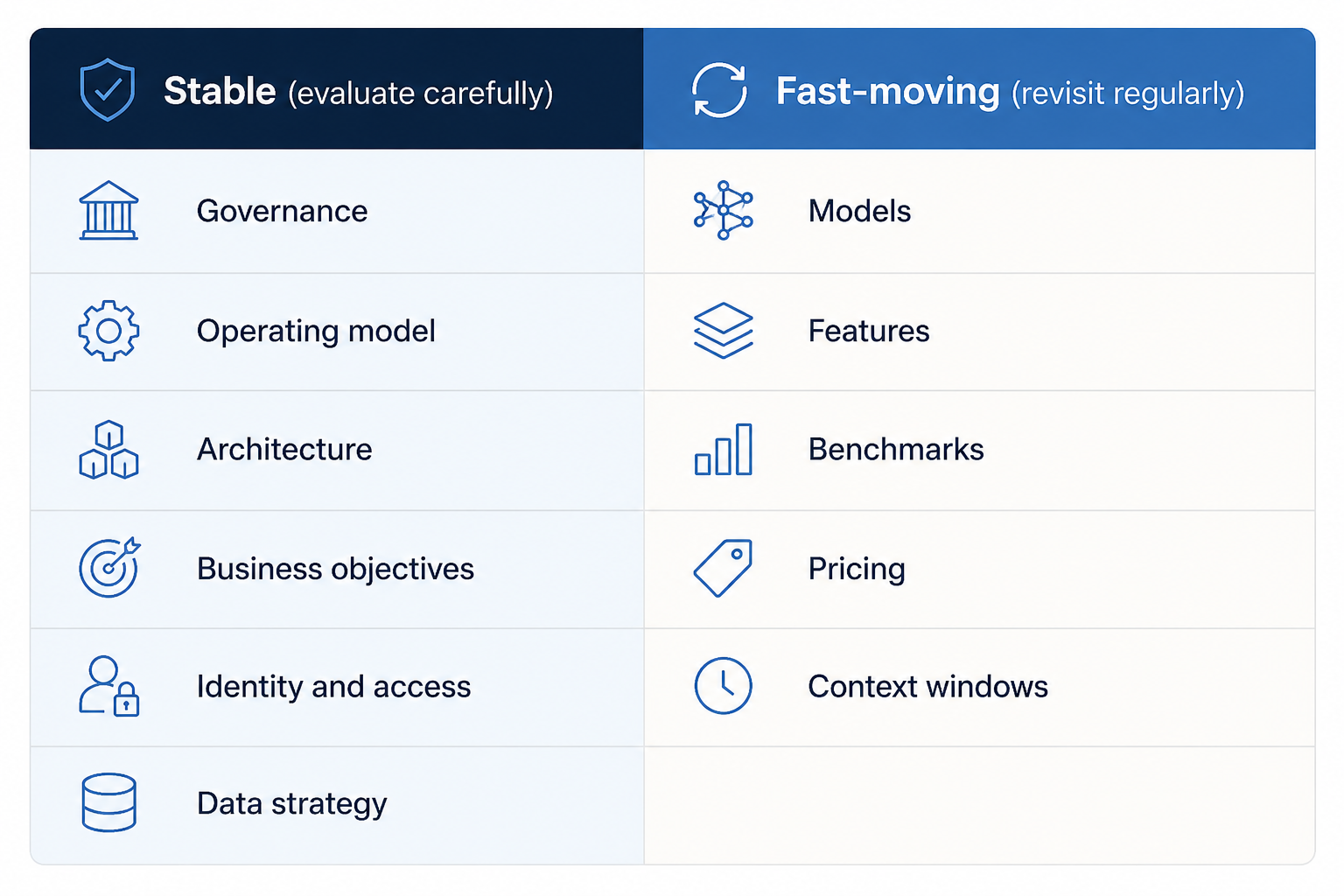
This is not an exhaustive list, and the boundary between the two columns can shift as a platform or market matures. But the general pattern holds across most enterprise AI procurement decisions observed to date. The items in the left column tend to justify extended evaluation, structured sign-off, and legal and governance review. The items in the right column tend to be more efficiently managed through a lighter, ongoing review process than through a single upfront decision treated as final.
A More Practical Procurement Approach
Traditional procurement is designed to resolve uncertainty before a decision is made: specifications are fixed, requirements are locked, and the contract reflects a settled understanding of what is being bought. Enterprise AI procurement increasingly involves a different discipline: distinguishing between uncertainty that justifies delaying a decision and uncertainty that is more practically managed after deployment begins.
Enterprise AI procurement does not require an organisation to predict where the market will be in three years. That prediction is not reliably available to anyone, including the vendors themselves.
What the decision does require is a clear view of which choices are expected to hold steady for years and which choices are expected to evolve monthly, sometimes without warning. Governance, operating model, architecture, and business objectives sit in the first category and tend to warrant the bulk of the evaluation effort. Model selection, feature sets, and pricing structures sit in the second, and are more often managed through ongoing review than through a single decision treated as permanent.
Organisations that keep waiting for the market to stabilise are, in practice, waiting for a condition that has not appeared and may not appear. Organisations that separate what is expected to last from what is expected to change are able to proceed under the same uncertainty, without pretending that uncertainty does not exist.
This article provides general commercial and procurement commentary only and does not constitute legal, financial, or professional advice.