
Enterprise AI Procurement Guide: A Decision Framework for First-Time Buyers
This guide introduces the Enterprise AI Procurement Decision Framework - six decision areas across the full AI capability lifecycle, from understanding the work to ongoing governance.

Most enterprise AI procurement processes begin in the same place. The vendor is selected before the organisation understands what it is building.
A demo impresses. A business unit applies pressure. A vendor's pricing looks manageable. The platform is procured. And then, sometime in the months that follow, the organisation discovers the questions it did not ask: what operating model will support this? What is the total cost? What happens if we need to leave? What does success actually look like, and who measures it?
This guide is written for IT leaders, procurement professionals, enterprise architects, finance leaders, and business decision-makers in Australian organisations who are approaching enterprise AI investment for the first time, or who want a structured way to think about the decisions involved before any vendor conversation begins.
Enterprise AI procurement is different from traditional software procurement in ways that matter commercially. The cost model is different. The governance requirements are different. The lock-in dynamics are different. And the failure modes are specific: they are not random. They follow predictable patterns that a structured approach can surface before they become expensive.
The framework below maps six decision areas across the enterprise AI capability lifecycle. It is designed as a starting point and a reference. Each section links to more detailed analysis on this site for organisations working through specific decisions.
The Enterprise AI Procurement Decision Framework
Enterprise AI procurement is best understood as a capability lifecycle, not a single purchasing event. The organisations that navigate it most effectively tend to be those that work through a consistent sequence of decisions rather than jumping to vendor evaluation as the first step.
This guide is structured around the Enterprise AI Procurement Decision Framework, a six-phase model that maps the decisions most organisations face across the full AI capability lifecycle. Enterprise AI procurement increasingly extends beyond contract award into adoption, governance, and ongoing commercial lifecycle management. The framework reflects that reality.
The six decision areas are:
UNDERSTAND → ASSESS → DESIGN → SELECT → ADOPT → OPTIMISE
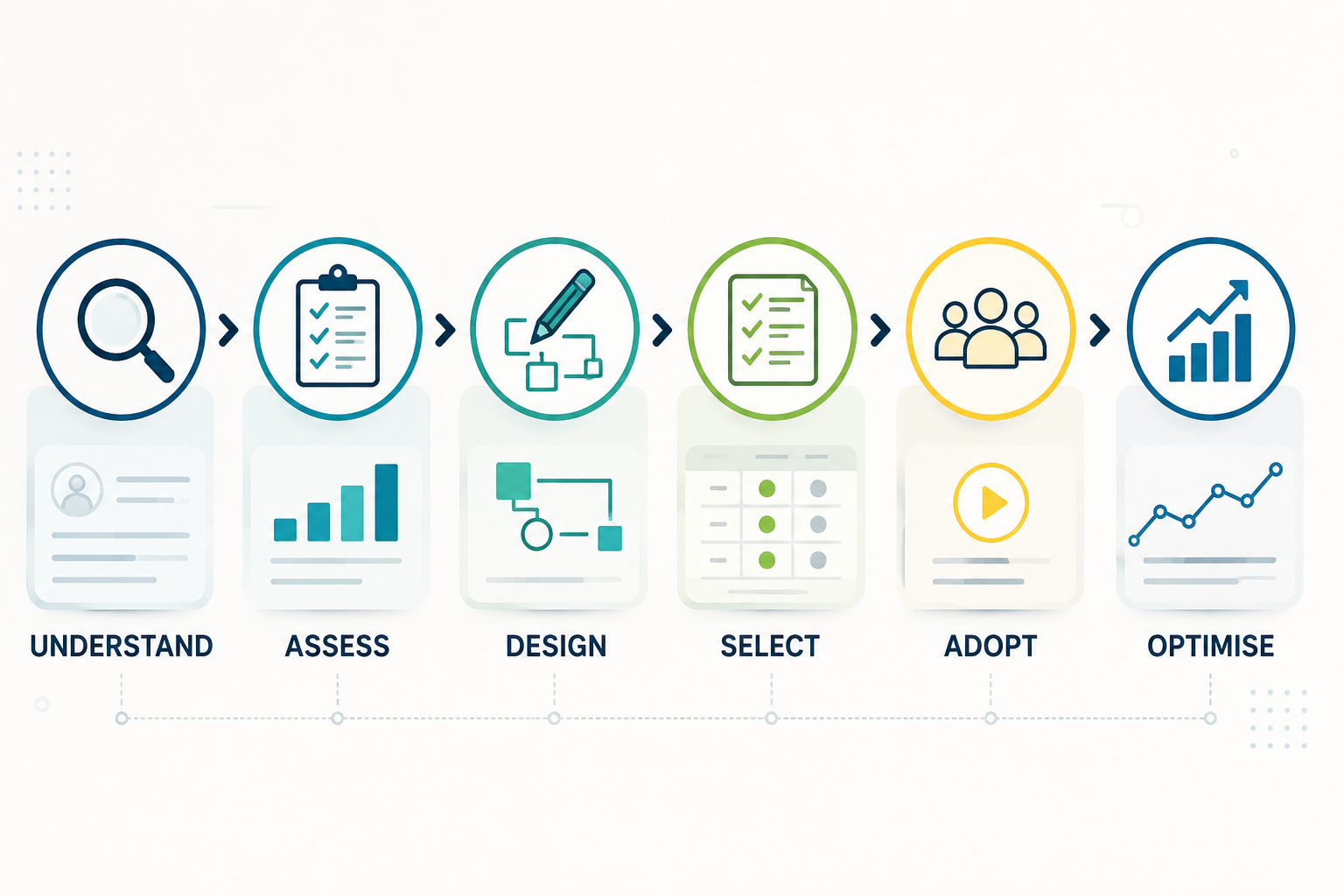
The sequence is not rigid. Decisions in later phases sometimes surface information that changes earlier ones. But the direction matters. Organisations that arrive at SELECT having completed UNDERSTAND, ASSESS, and DESIGN are in a fundamentally different commercial position from those that begin with vendor evaluation and work backwards.
PART 1: UNDERSTAND
You Are Building a Capability, Not Buying Software
The language used to describe enterprise AI procurement shapes how organisations approach it.
"Buying AI" positions the decision as a purchasing event. It draws procurement attention toward vendors, features, and licence pricing. It implies that once the purchase is made, the work is done.
Building an enterprise AI capability positions the decision differently. It asks: what are we trying to change about how work gets done, and what does the organisation need in place for that change to stick? Platform selection is one element of that question, not the whole of it.
The distinction has practical consequences. Capability thinking draws in operating model design, readiness assessment, governance planning, and adoption strategy, all of which have material bearing on whether the investment delivers value. Procurement thinking tends to skip these and discover them as problems later. For simplicity, this guide refers to "the AI capability," though many organisations will ultimately operate multiple AI capabilities across generative AI, predictive AI, automation, and agents.
Decision 1: What Work Are We Trying to Improve?
The most common opening question in enterprise AI evaluation is: which AI platform is best for our organisation? The more useful opening question is: what work are we trying to improve?
These two questions produce different conversations. The first positions vendors as the starting point. The second positions the organisation's own operations.
A useful way to work through this is from strategy down to use cases, not from use cases up:
- Business strategy defines what the organisation is trying to achieve.
- Business capability defines what the organisation does to deliver on that strategy.
- Business processes define how that capability operates.
- Work is what people actually do within those processes.
- Pain points are where the work fails, slows, or costs more than it should.
- Use cases are where AI addresses those pain points.
Most organisations start at use cases. Many vendors encourage this, because a use case is something a platform can be demonstrated against. But use cases defined without reference to the work they sit within are often shallow. They reflect what the AI can do, not what the organisation actually needs.
Working through this sequence before vendor engagement changes the shape of the procurement. Use cases defined from the work up tend to be more specific, more measurable, and more likely to deliver outcomes that matter.
PART 2: ASSESS
Decision 2: Are We Actually Ready?
Readiness is often treated as a deployment-phase question. In practice, readiness gaps that are not identified before vendor selection tend to extend timelines, increase costs, and reduce the value of the deployment.
Five readiness dimensions are commonly relevant for Australian organisations approaching enterprise AI investment:
Business readiness. Are the business problems clearly defined? Is there executive sponsorship for the investment? Are the expected outcomes measurable, and does someone own them? Organisations that cannot answer these questions before vendor evaluation often find that the pilot answers them instead, which delays everything else.
People readiness. AI deployment amplifies the need for change management rather than reducing it. Whether the organisation has the internal capability, leadership commitment, and change capacity to drive adoption is a readiness question, not an implementation question.
Technology readiness. Integration complexity, security architecture, and identity and access management requirements vary significantly between deployments. Technical readiness assessment prior to vendor evaluation can affect which platforms are viable and which carry significant integration overhead.
Data readiness. AI capabilities depend on data. Where data exists in structured, accessible form, deployment is more straightforward. Where it is fragmented, inconsistent, or held in legacy systems, data preparation can represent a significant proportion of total implementation cost. This is a cost category that often does not appear in vendor pricing discussions. Sensitive, regulated, and sovereign datasets often require different deployment approaches from public or lower-risk information, which can affect platform selection, architecture, and commercial structure.
Governance readiness. Governance frameworks, policies, and oversight structures are more effectively built before deployment than retrofitted afterward. Organisations that assess governance readiness before vendor selection are better placed to evaluate whether a platform's governance tooling is adequate for their requirements.
Who Needs to Be Involved?
Enterprise AI procurement commonly draws in functions that are often less involved in traditional software procurement. Understanding who carries which decision-making responsibility before the process starts reduces delays later.
Functions typically involved include business leadership (problem definition, outcome ownership), IT (technical evaluation, integration planning), enterprise architecture (platform strategy, architecture design), cyber security (non-functional requirements, risk assessment), legal and privacy (data handling, regulatory context), finance (budget, cost modelling, business case), procurement (commercial evaluation, contract), change management (adoption planning, training design), and executive sponsorship (governance, investment approval). In larger organisations, risk and internal audit functions are also commonly involved, particularly where AI deployment intersects with regulatory obligations or significant operational risk.
The most common resourcing gap is change management. Organisations frequently assign technical and procurement resources to the evaluation phase without equivalent investment in adoption planning. This imbalance tends to surface as an adoption problem after deployment.
PART 3: DESIGN
Decision 3: What Enterprise AI Capability Do We Need?
The design phase is where most enterprise AI guides skip ahead to vendor selection. It is also where many procurement processes make decisions that are difficult to unwind.
Three design decisions typically precede vendor evaluation: operating model, platform strategy, and architecture.
Operating Model: Who Owns This?
The operating model defines who owns the AI capability on an ongoing basis. It is one of the least discussed and most consequential design decisions in enterprise AI deployment.
The questions it answers: Who approves new AI use cases? Who owns AI governance policy? Who manages vendor relationships? Who monitors output quality? Who responds when the AI system produces incorrect or harmful outputs? Who owns the AI roadmap?
Four operating models are commonly used:
A centralised AI team owns capability across the organisation. Governance is consistent. The model can become a bottleneck as demand from business units scales.
A federated model gives business units ownership of their AI capabilities within centrally defined standards and oversight. It is more responsive to business needs, but governance consistency requires active management.
A business-led model with central governance has business units driving deployment decisions while a central function owns policy, risk, and oversight. This is common in regulated industries where compliance accountability needs to sit centrally.
A Centre of Excellence combines central standards with cross-functional support, typically adopted by organisations at a more advanced stage of AI maturity.
The operating model is often as important as, or more important than, the platform itself in determining long-term success. Organisations that define the operating model before deployment tend to scale AI capability more effectively than those that treat it as a post-go-live design problem. Operating models also tend to evolve: many organisations begin with a centralised model, transition to a Centre of Excellence as demand grows, and move toward a federated structure as AI capability matures across the business.
Platform Strategy: Build, Buy, Compose or Extend?
Platform strategy asks how the organisation intends to establish its enterprise AI capability.
Four broad approaches are observed in the market:
Extend existing investment. Many Australian organisations hold enterprise contracts with providers that now include AI capabilities. Extending these investments reduces integration complexity and leverages existing commercial relationships. The trade-off is that bundled AI features typically offer less configurability and shallower governance tooling than dedicated platforms.
Buy a dedicated AI platform. Dedicated platforms offer deeper capability and more sophisticated governance tooling, with the trade-off of a new vendor relationship, new contracts, and significant integration requirements.
Build using foundation model APIs. Accessing AI through model APIs rather than platforms offers flexibility and lower per-unit cost at scale, but requires in-house capability to build, manage, and govern the resulting systems. The enterprise AI build vs buy guide covers this decision in detail.
Compose an enterprise AI ecosystem. Many larger organisations are not choosing a single platform. They are building an ecosystem: one provider for productivity and collaboration, another for specialised reasoning or coding tasks, internal agents connecting the two, and existing SaaS AI features running alongside. A composed approach can offer flexibility and best-of-breed capability, but introduces its own governance, integration, and cost complexity.
Platform strategy decisions commonly precede vendor evaluation. Arriving at vendor evaluation without a clear platform strategy means the strategy is often set implicitly by the vendor selected, rather than by the organisation.
Where AI Fits in Enterprise Architecture
The AI capability does not sit in isolation. It operates within a broader enterprise architecture. Understanding where it fits within that architecture affects integration complexity, security requirements, data governance, and total cost.
A common architectural view positions the layers as:
- Business (processes, workflows, outcomes)
- Applications (line-of-business systems, productivity tools)
- Security and Governance (policies, controls, risk management, compliance)
- Enterprise AI Capability (the AI platform or API layer)
- Enterprise Data (knowledge bases, structured data, content repositories)
- Integration (APIs, connectors, middleware)
- Identity (access management, authentication, role-based controls)
- Cloud (infrastructure, hosting, compute)
- Models (underlying AI models, whether proprietary or accessed via API)
Understanding how the AI capability connects to each layer, and where the integration complexity sits, is an architecture decision that informs platform evaluation criteria.
PART 4: SELECT
Decision 4: Which Solution Best Supports Our Capability?
Formal vendor evaluation begins here. Not before.
Organisations that arrive at this phase having worked through the prior three phases are evaluating vendors against defined requirements: specific use cases, clear readiness constraints, a chosen platform strategy, and a view of the operating model the platform will need to support. That is a different exercise from open-ended vendor exploration.
The Enterprise AI Evaluation Lens
Five dimensions structure a rigorous enterprise AI vendor evaluation:
Value. Does the platform deliver meaningful value against the use cases and outcomes defined in the understand phase? Value assessment is not a demo. It is a structured pilot against the organisation's own use cases, with its own data, in conditions that approximate the real operating environment. Vendor demonstrations typically showcase the platform under controlled conditions. The pilot tests what it actually does in the organisation's environment, with its own data and operating constraints.
Fit. Does the platform integrate with the organisation's existing architecture, data infrastructure, identity management, and security framework? Fit assessment is architectural and technical, not a feature checklist.
Risk. What are the security, privacy, data handling, model stability, and vendor concentration risks? Risk assessment relies on non-functional requirements, which function as gating criteria: they narrow the field before functional evaluation begins. The enterprise AI platform evaluation criteria guide covers non-functional requirements in detail.
Cost. What is the total cost of ownership across the full deployment lifecycle? Not the licence price. Total cost including implementation, integration, data preparation, training, governance, and ongoing operational management.
Change. What does adoption require? What change management, training, and workflow redesign is needed to realise value? Change is often the most underweighted evaluation dimension and the most overrepresented source of post-deployment problems.
The Hidden Costs
Licence price and total cost of ownership are different numbers. The gap between them is often larger than procurement teams anticipate.
Cost categories commonly absent from the headline price include: implementation and configuration, identity and access management integration, data preparation and quality work, system integration and API development, user training and change management, ongoing governance and monitoring, prompt optimisation and maintenance, support and service management, and the cost of assessing and managing model updates as the platform evolves.
A more complete treatment of these cost categories is in the enterprise AI total cost of ownership guide, including how to model variable cost components before committing to a pricing structure.
Commercial Models
Three pricing structures are commonly observed in enterprise AI:
Seat-based licensing. A fixed cost per user per period. Predictable at the licence level. May not reflect actual usage patterns, and may create governance incentives to restrict access rather than expand it.
Consumption-based pricing. Cost tied to usage, typically measured in tokens, API calls, or queries. Manageable at low volumes; the exposure can scale unexpectedly with agentic workflows or high-volume deployments.
Hybrid models. A base platform fee combined with consumption-based charges. Increasingly common in enterprise AI contracts. Provides a cost floor with variable upside based on usage. Many enterprise agreements combine more than one pricing mechanism across different products or user groups, making effective cost modelling dependent on understanding how these components interact.
The pricing structure determines where cost risk sits. Organisations that understand the structure before committing are in a better position to model realistic total cost and to manage commercial exposure. The enterprise AI pricing models guide covers the mechanics of each model.
Commercial Structuring
The commercial terms of an enterprise AI contract shape the organisation's flexibility, cost exposure, and risk position for the duration of the agreement. This is where the procurement function adds distinct value beyond platform evaluation.
Commercial structuring in enterprise AI typically addresses how commitment periods and annual review mechanisms are handled, how consumption costs are bounded or managed at volume, what renewal leverage exists and when it is established, how exit assistance and data portability are defined, and what audit rights the organisation holds over vendor compliance with agreed terms. These are not afterthoughts. They are decisions made at the point of commercial engagement, and their consequences run for the life of the contract.
Organisations with well-resourced commercial evaluation tend to be in a stronger position at both initial contract execution and at renewal. The organisations in the weakest renewal position are typically those that treated commercial terms as secondary to platform capability during initial selection.
Design for Optionality
Enterprise AI evolves at a pace that makes long-term certainty difficult. Vendors update models, change pricing, and alter product direction. The regulatory environment continues to develop. Organisational needs change.
A principle that appears consistently in well-structured enterprise AI procurement is designing for optionality: structuring commercial and technical arrangements that preserve enough flexibility to adapt as the market and the organisation's needs evolve, rather than optimising purely for the capabilities available at the point of contract entry.
This is not an argument against commitment. Commitment is often required to access the commercial terms, implementation support, and vendor priority that enterprise deployments need. It is an observation about how that commitment is structured. The enterprise AI vendor lock-in and exit costs guide covers what optionality looks like in practice, and where the inflexibility in most enterprise AI contracts actually sits.
PART 5: ADOPT
Decision 5: How Do We Make AI Successful?
Deployment is not adoption. A platform can be technically live, integrated, and available to all intended users without any meaningful change in how work gets done. Adoption is when users integrate AI into their workflows in ways that change outcomes. The two frequently do not happen at the same time.
The gap between deployment and adoption is where most enterprise AI value is lost.
Designing the First Pilot
Pilots are most effective when they are designed to answer specific questions rather than to demonstrate the platform. The questions vary: Does this platform perform against our data in our operating context? Do users find it faster or more useful than existing tools? Does output quality meet the threshold needed for this use case? What does the governance overhead look like in practice?
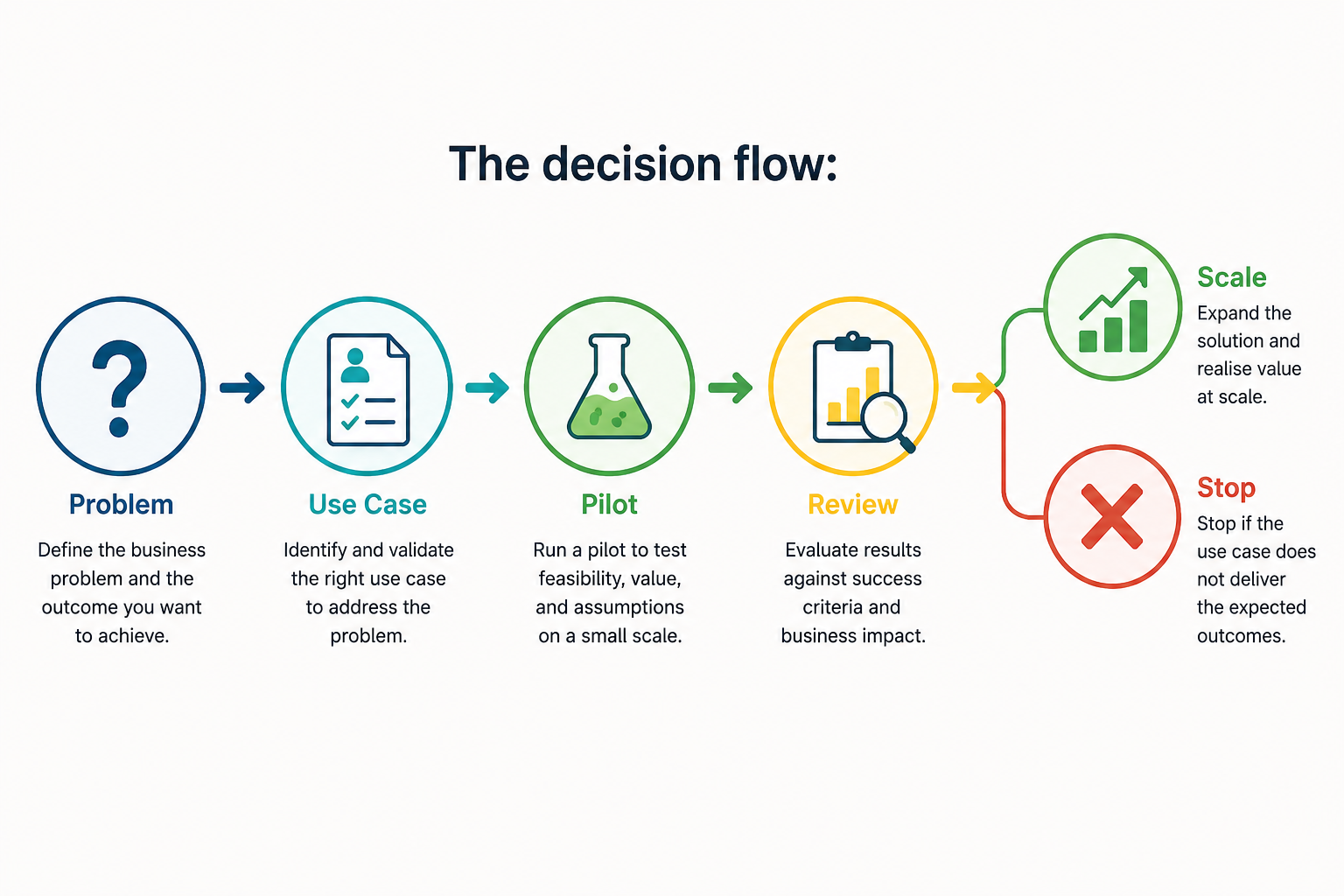
A useful pilot structure: one defined problem, one use case, one team, a defined timeframe, measurable success criteria, and a clear decision gate at the end. A pilot without a decision gate is an extended demo.
The outcome of a pilot is a decision: scale this use case, adjust the approach, or stop. Organisations that run pilots without a clear decision framework attached often find themselves in extended pilot phases with no clear path to value.
The decision flow: Problem → Use Case → Pilot → Review → Scale or Stop.
Change, Training, and Measurement
KPIs at the adoption stage address different questions from the business case. The business case asks whether the investment will deliver value. The adoption measurement framework asks whether it is delivering value now, and what is preventing more.
Adoption measurement looks at usage patterns, not licence activation. It asks whether AI is changing how work gets done, not whether it is technically available to the people expected to use it. These are not the same thing, and the gap between them is often significant.
The enterprise AI change management guide covers how to structure the adoption phase, including the role of superuser programmes, workflow redesign, and the measurement frameworks that distinguish real adoption from surface-level usage.
PART 6: OPTIMISE
Decision 6: How Do We Maximise Value Over Time?
Procurement does not end at contract signature. Enterprise AI is a continuously governed and continuously optimised capability, and the decisions made post-contract often determine whether the investment ultimately delivers value.
The post-deployment lifecycle: Deploy → Adopt → Govern → Measure → Improve → Renew → Exit.
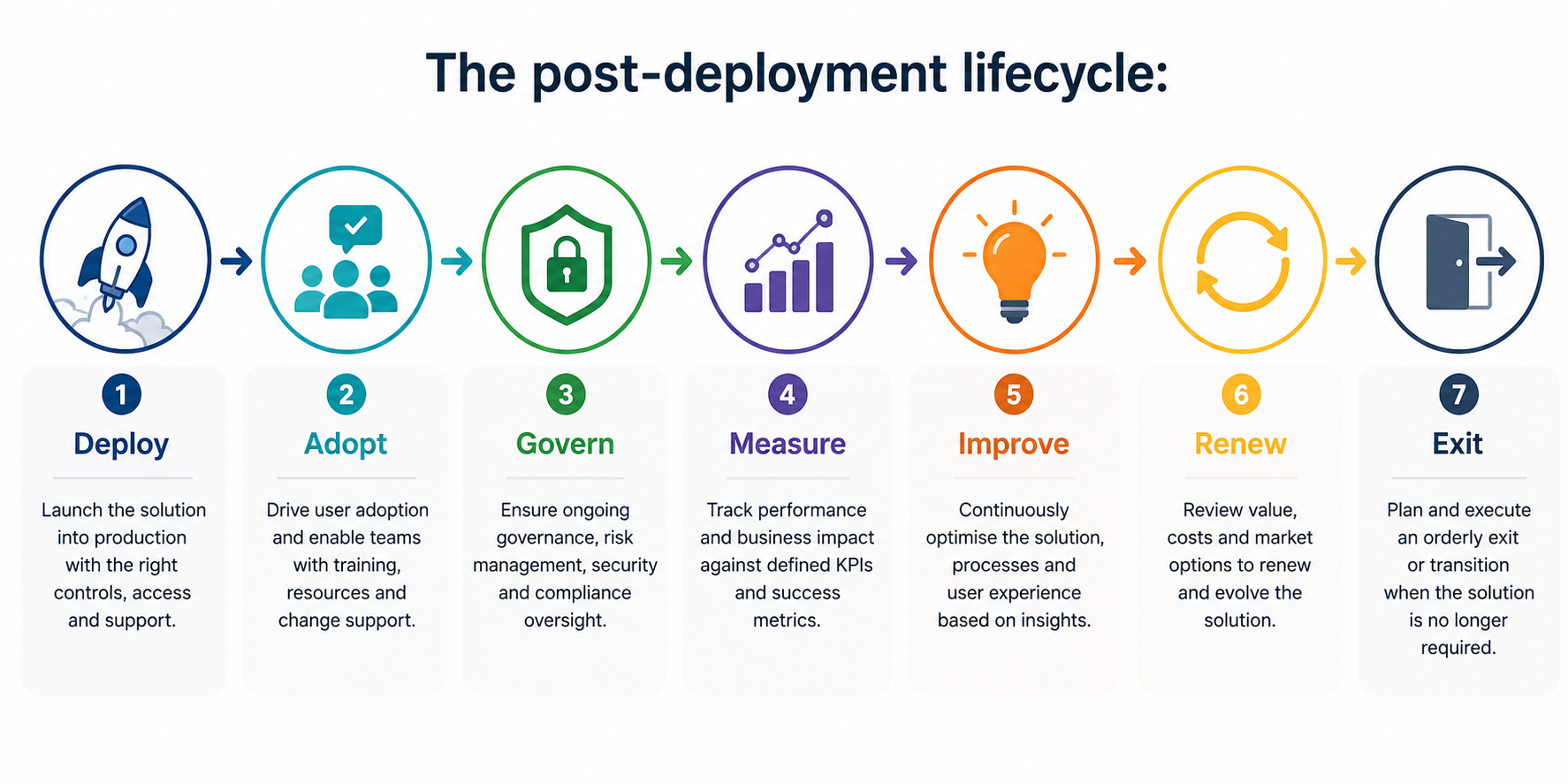
Vendor relationship management evolves from the contract and onboarding phase into ongoing performance monitoring, consumption tracking, and model update assessment. New use cases expand the footprint of the capability and introduce new governance questions. Value measurement at twelve months reflects real operational experience in ways that go-live measurement cannot.
Enterprise AI also requires ongoing assurance activities: output evaluation, prompt regression testing, model update assessment, and continuous validation against business objectives. Unlike traditional software, AI systems produce probabilistic outputs and model behaviour can change over time, which means assurance is a continuous operational function rather than a project-phase activity.
The renewal and exit decision is itself a procurement event. Organisations that have tracked total cost of ownership, vendor performance, and market alternatives during the contract term are in a stronger commercial position at renewal than those that have not. Exit planning is not a failure scenario. It is a normal component of ongoing vendor management.
The enterprise AI governance guide covers the ongoing governance requirements in full, including how organisations structure oversight, manage model lifecycle, and maintain accountability as the AI capability scales.
Five Common Procurement Mistakes
1. Starting with vendors before understanding the work. The most common and most consequential mistake. Vendor conversations define the use cases rather than the organisation's own analysis of its work and pain points. The result is a platform that fits the vendor's strengths rather than the organisation's actual needs.
2. Treating the pilot as a final evaluation rather than a decision gate. A pilot that does not end with a clear decision is an extended demo. Pilots are most valuable when they are designed to answer specific questions and when the findings drive a concrete next step.
3. Budgeting for the licence and not the total cost of ownership. Implementation, integration, data preparation, training, governance, and ongoing operational management are all cost categories that sit outside the licence fee. Procurement teams that discover these costs after contract execution are consistently surprised by the gap.
4. Deferring the operating model to post-deployment. Who owns prompts? Who approves new use cases? Who manages model governance? Who responds when outputs are wrong? These questions are often left unanswered until deployment exposes them as structural gaps. Defining the operating model before deployment is more effective than designing it under operational pressure.
5. Treating contract signature as the end of the procurement process. Vendor performance, consumption costs, model updates, and renewal terms all continue to evolve after the contract is signed. Organisations that treat contract execution as closure rather than the beginning of an ongoing commercial relationship often find themselves in a weak position at renewal.
Frequently Asked Questions
Where does an organisation typically start if it has not deployed enterprise AI before?
The most common effective starting point is defining the business problem before evaluating technology. Organisations that begin by identifying which specific work they are trying to improve, and what measurable outcome they are targeting, are in a better position to evaluate vendors than those who begin with an open-ended market assessment. The enterprise AI procurement guide for Australian organisations covers the full scope of decisions involved.
Who needs to be involved in enterprise AI procurement?
The core group typically includes IT, enterprise architecture, cyber security, legal and privacy, finance, and procurement. The function most commonly underrepresented is change management, which is also the function whose absence most frequently explains adoption failures. Organisations without active executive sponsorship commonly find that governance decisions and budget approvals stall at the points where they matter most.
What is the biggest commercial risk in enterprise AI procurement?
Three risks appear consistently. The first is underestimating total cost of ownership: the gap between licence price and full deployment cost is often significant, covering implementation, integration, data preparation, training, and ongoing operational management. The second is entering inflexible commercial arrangements that limit the organisation's ability to adjust as the market and its own needs evolve. The third is failing to achieve adoption: an AI capability that is technically deployed but not embedded in how work gets done delivers poor return on investment regardless of platform quality or licence cost.
What is the difference between a pilot and a deployment?
A pilot is a structured test designed to answer specific questions about whether a platform can deliver value in the organisation's operating context. A deployment is the commitment to operate the capability at scale. The distinction matters because many organisations move from pilot to deployment without a clear evaluation of what the pilot found. A pilot that does not end with a defined decision point tends to become an extended deployment without the governance and operating model design that a full deployment requires.
What is the biggest mistake organisations make when selecting a vendor?
Selecting a vendor before defining the operating model. The platform that is selected partly determines what operating model is feasible. The operating model that is designed partly determines what platform requirements are non-negotiable. Doing these in the wrong sequence means the operating model is shaped by the platform rather than the other way around.
What does "design for optionality" mean in practice?
It refers to structuring commercial and technical arrangements in ways that preserve flexibility to adapt as the market and the organisation's needs change, rather than optimising purely for the capabilities available at the point of contract entry. Enterprise AI vendor contracts vary significantly in how they address data portability, configuration export, and transition assistance. The architecture decisions made at deployment affect what any future exit or platform change would actually cost.
Further Reading
Strategy and Procurement
- The Definitive Guide to Enterprise AI Procurement in Australia
- Enterprise AI Procurement: Why Enterprise AI Challenges Traditional ICT Procurement
- What Must Be Defined Before Vendor Evaluation
Commercial and Cost
- Enterprise AI Pricing vs Total Cost of Ownership
- The Hidden Costs of Enterprise AI
- Enterprise AI API Pricing: How to Model Token Costs
- Enterprise AI Vendor Lock-in and Exit Costs
- Enterprise AI Build vs Buy
Vendor Evaluation
- Enterprise AI Platform Evaluation Criteria
- Enterprise AI Vendor Evaluation Scorecard
- The Enterprise AI RFP Blueprint
- Vendor Reference Checks in Enterprise AI Procurement
Governance
- The Definitive Guide to AI Governance for Australian Enterprises
- Enterprise AI Governance Frameworks for Australian Organisations
- Enterprise AI Governance Operating Model
- Agentic AI Governance: Risk and Strategy for Enterprise Deployments
- Enterprise AI Data Residency Explained
Adoption and Change
- Enterprise AI Change Management: The Complete Guide
- Workflow Redesign for Enterprise AI
- How to Measure Enterprise AI Adoption
- Enterprise AI Training Design
- Enterprise AI Value Realisation After Go-Live
Enterprise AI procurement is fundamentally a sequence of interdependent decisions. The organisations that navigate it most effectively are not those with the largest budgets or the most sophisticated technology teams. They are those that identify the right decisions, address them in the right sequence, and treat the capability as something to be built and managed over time rather than purchased and deployed.
The framework in this guide is designed to help organisations know which decisions are theirs to make, and when.
This article provides general commercial and procurement commentary only and does not constitute legal, financial, or professional advice.