
Should You Engage an Enterprise AI Consultant? A Procurement Perspective
Enterprise AI consultants can add significant value through specialist expertise, market insight, and practical experience. This article examines the different types of enterprise AI consulting engagements, where external expertise may add value, and the procurement considerations involved.

"Enterprise AI consultant" is a broad label that covers a wide range of engagements. Depending on the organisation's objectives, who is engaged, and how the brief is framed, the resulting output might be an AI readiness assessment, an enterprise AI strategy, a governance framework, an implementation plan, change management and adoption support, or all of the above. Each type of output can be genuinely useful within its own scope, but the categories are not interchangeable, and strong performance in one area does not necessarily translate to another.
None of these outcomes is inherently right or wrong; each reflects a different kind of expertise applied to a different kind of problem. The more useful question is whether the advice reflects the organisation's requirements, the consultant's specific expertise, and the commercial model behind the engagement. That distinction is often overlooked, and it is the difference between advice that is well matched to the organisation and advice that is simply well matched to the adviser's own area of practice.
Many organisations achieve excellent outcomes by engaging external advisers. The purpose of this article is not to distinguish between "good" and "bad" consultants, but to help organisations identify the type of expertise that best matches the problem they are trying to solve.
This article is written for CIOs, procurement managers, IT managers, enterprise architects, CFOs, and digital transformation leaders in Australian organisations considering whether, and how, to engage external expertise for an enterprise AI initiative. It looks at when consultants tend to add genuine value, the different categories of consultant operating in this market, how commercial models shape engagements, and the questions procurement teams commonly ask before a statement of work is signed.
Before Engaging Anyone, Define the Problem
The most consequential procurement decision in this process happens before any consultant is contacted. Organisations commonly describe the requirement as "we need an AI consultant." That description rarely reflects what is actually needed.
The underlying requirement is often more specific: executive education on what enterprise AI can and cannot do, a defined AI strategy, use case definition, a governance framework, an architecture review, vendor evaluation support, implementation delivery, change management, or procurement support during contract negotiation. Each of these is a different kind of work, drawing on a different kind of expertise.
Just as procurement teams typically define requirements before approaching the software market, defining the specific capability gap before approaching the consulting market tends to produce a more useful engagement. A loosely defined requirement produces a loosely scoped statement of work, and a loosely scoped statement of work is difficult to evaluate against alternatives or hold to account against outcomes. This is the procurement foundation the rest of this article builds on.
Why Enterprise AI Consultants Add Genuine Value
External expertise tends to add the most value in a defined set of situations. Enterprise AI strategy development benefits from outside perspective when internal teams are close to day-to-day operations and have limited visibility into how peer organisations, or the broader market, are approaching similar decisions. Governance and operating model design benefits from experience across multiple organisations, since these structures are rarely built more than once inside any single company.
Executive workshops and architecture reviews can accelerate alignment that might otherwise take months of internal debate. Use case prioritisation benefits from a structured method and from having facilitated similar exercises before. Procurement support and vendor evaluation benefit from market knowledge that is difficult for an internal team to build without evaluating multiple platforms across multiple engagements. Implementation planning and organisational change management benefit from delivery experience, particularly in organisations running their first substantial enterprise AI deployment.
Organisations with considerable internal capability, built through prior deployments or through an established platform team, tend to need less external support across most of these categories. The value of a consultant scales with the size of the internal capability gap, not with the scale of the AI initiative itself. A large, well-resourced programme run by an experienced internal team may need very little outside help. A smaller programme run by a team encountering these decisions for the first time may draw considerably more value from it.
Another area where experienced advisers often add considerable value is helping organisations navigate decisions they have not encountered before. Many enterprise AI programmes introduce unfamiliar questions around governance, implementation sequencing, organisational change, operating models, and long-term adoption. A consultant who has guided multiple organisations through similar journeys can often help identify risks, dependencies, and decision points that internal teams may not yet recognise, reducing uncertainty throughout the programme rather than simply delivering a predefined set of outputs.
Not Every Enterprise AI Consultant Does the Same Job
"Enterprise AI consultant" is an umbrella term that spans a wide range of practices, and the differences between them matter more than the shared label suggests.
Strategy consultants work at the level of enterprise strategy, operating model design, and executive advice. Their output tends to be a framework or a roadmap rather than a deployed system.
Enterprise architects focus on architecture, integration, and platform strategy: how systems connect, where data flows, and how a chosen platform fits alongside the organisation's broader build versus buy position.
Systems integrators focus on implementation, delivery, and migration. Their value is demonstrated in deployed systems rather than in documents, and their commercial incentives are generally aligned with completing and expanding delivery work.
Platform specialists carry deep expertise in a single ecosystem, whether Microsoft, AWS, Google, OpenAI, or Anthropic. Their recommendations will often reflect the platform ecosystems in which they have the greatest implementation experience, and that expertise can be a considerable advantage where an organisation has already selected that platform.
Managed service providers operate enterprise AI systems after deployment, taking on the ongoing monitoring, tuning, and support work a deployment continues to need once it is live.
Evaluation criteria that suit one category can be a poor fit for another. Assessing a systems integrator on strategic vision, or a strategy consultancy on delivery throughput, tends to produce a mismatch between what is measured and what the engagement is meant to deliver.
Enterprise AI Consulting Is Not One Engagement
Enterprise AI programmes rarely draw on a single type of consulting expertise once, at the outset, and then conclude. Organisations more commonly return to the external market at several distinct points across a programme's life: for strategy and executive alignment, for procurement and vendor evaluation, for architecture and integration design, for implementation and delivery, for change management, and for optimisation once a system is in production.
Each of these phases can draw on different expertise, delivered by different people. A single consultancy with broad capability may cover several phases under one engagement, while other organisations combine specialist firms, each brought in for the phase that matches their strength, across the life of the programme.
Viewed this way, enterprise AI consulting is less a single transaction than a recurring input into a programme that continues to evolve. Treating the first engagement as the only one worth planning for tends to underestimate how many of these decision points a substantial AI programme actually contains.
Independence Is a Spectrum
It is tempting to sort consultants into two categories: independent advisers and biased ones. That framing does not hold up well in practice. Commercial independence in enterprise AI consulting sits on a spectrum rather than in two boxes, and every point on that spectrum can produce good advice.
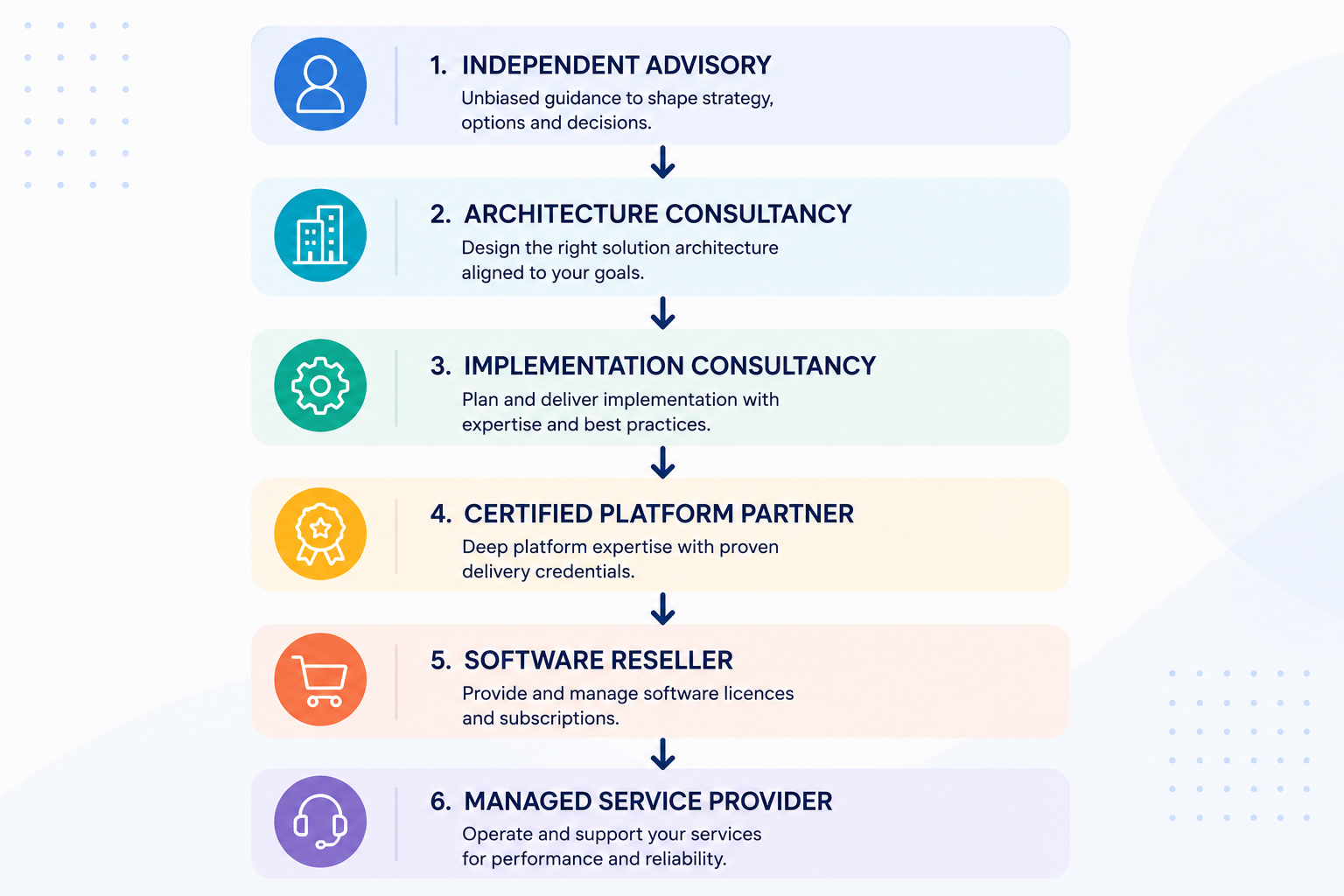
Every position on this spectrum can provide excellent advice. What changes along the spectrum is not the quality of the advice but the incentives shaping it. An independent adviser has limited exposure to how their recommendations perform in an actual deployment. A managed service provider has direct, ongoing exposure to how the recommended platform behaves in production, because they are the ones supporting it afterward. Neither position is inherently superior. Each carries a different strength and a different blind spot.
Understand the Commercial Model
Consultants can also operate as implementation partners, certified partners, software resellers, referral partners, or managed service providers, and revenue can come from advisory fees, implementation work, software resale margin, managed service contracts, or referral arrangements with platform vendors.
None of these commercial models is inherently inappropriate. A firm with deep implementation experience on a specific platform often brings capability that a purely advisory firm does not have, and that experience is a genuine strength rather than a conflict to be managed away. What matters for procurement purposes is transparency about the model in use, because commercial structure can shape platform familiarity, implementation approach, architectural recommendations, and the range of options actually considered during an engagement.
Commercial relationships influence more than product recommendations. They can also influence implementation methodology, architecture preferences, support models, and long-term operating approaches.
The relevant question is not whether a consultant has a commercial relationship with a platform vendor. Many capable consultants do. The relevant question is whether that relationship is disclosed clearly enough for the organisation to weigh it alongside the advice itself.
Due Diligence Questions Before You Engage
On capability. Which enterprise AI projects, of a similar scale and industry, has the consultant delivered? What was the outcome, and what would the consultant approach differently on a similar engagement today?
On current knowledge. Given how quickly the underlying market moves, how does the consultant keep recommendations current, and when was their most recent hands-on engagement with the platforms under discussion?
On commercial model. Does the consultant implement platforms? Do they resell software? Are they a certified partner with any of the vendors under consideration? Do they receive referral revenue tied to a recommended path?
On alternatives considered. Which other approaches were evaluated before arriving at this recommendation, and why were they set aside? This question tends to reveal more about the quality of the advice than asking how many platforms a consultant is familiar with.
On market sensitivity. What assumptions underpin this recommendation, and how sensitive is it to changes in the AI market?
On knowledge transfer. Does the engagement leave the organisation more capable of making similar decisions independently in future, or does it create ongoing dependence on the same adviser for decisions the organisation could learn to make internally?
On accountability. How will success be measured, what deliverables will exist at the end of the engagement, and which decisions remain the organisation's to make regardless of what the consultant recommends?
What Good Enterprise AI Advice Looks Like
The quality of the advice is a more reliable signal than the reputation of the firm providing it. Good enterprise AI advice tends to share a set of characteristics regardless of which category of consultant is providing it.
It starts from business objectives rather than from platform capability, explores more than one option, and explains the trade-offs between them rather than presenting a single path as though it were the only one available. It documents the assumptions underneath its conclusions, acknowledges the areas of genuine uncertainty rather than presenting forecasts as settled fact, and distinguishes between what the evidence shows and what the consultant believes based on experience. It explains why alternative approaches were set aside, not only why the recommended approach was chosen. And it leaves the organisation with more internal capability than it had before the engagement began, rather than more dependence on the firm that provided it.
Consultants Do Not Replace Internal Ownership
Enterprise AI consultants can provide strategy, specialist expertise, and delivery support, but accountability for organisational outcomes remains with the organisation. Governance decisions, risk appetite, business priorities, and procurement decisions ultimately remain internal responsibilities, regardless of how experienced the adviser is or how confidently a recommendation is delivered.
This distinction shapes how an engagement is best structured. Treating a consultant's recommendation as the organisation's decision, rather than as input to it, tends to blur a line that is worth keeping clear. Current procurement practice generally treats external advice as informing decision-making rather than substituting for it, with sign-off, risk ownership, and ongoing accountability sitting with the organisation throughout and after the engagement.
That accountability does not end when the statement of work does. A consultant may move on to the next engagement once deliverables are handed over, but the organisation continues living with the consequences of the decisions made, long after the relationship has concluded.
When You May Not Need a Consultant
External advice is not a default step in every enterprise AI decision. Straightforward licence renewals, small productivity pilots built on well-understood platforms, organisations with mature internal AI capability, teams with existing enterprise architecture expertise, and vendor-supported implementations with strong onboarding are all situations where the value an outside adviser adds may be limited.
External advice tends to be most valuable when it closes an actual capability gap, including the kind of organisational and workforce change that a first enterprise AI deployment commonly surfaces. Where the relevant expertise already exists inside the organisation, engaging a consultant to duplicate it adds cost without adding much beyond what internal teams could produce on their own. The pace of change in enterprise AI also means organisations should consider whether their view of the market remains current, as platforms, commercial models, and implementation approaches can change and evolve significantly between major procurement exercises.
The Procurement Sequence
The considerations above follow a natural sequence, and keeping that sequence in order is a useful discipline in itself.
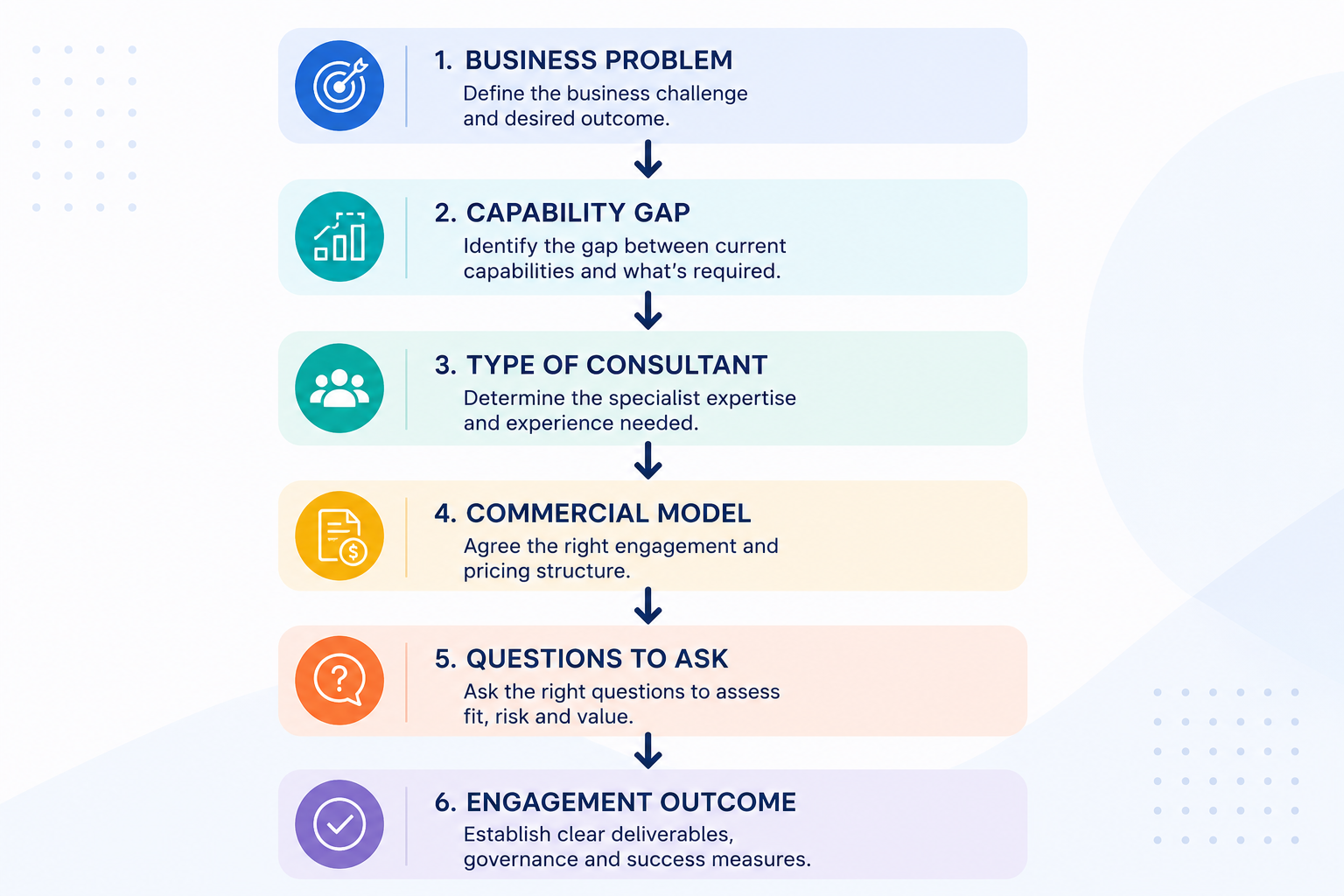
Reversing this sequence, starting from a consultant's name or a platform's reputation and working backward to a business problem, is a common pattern and a difficult one to unwind once an engagement is underway. Working through the sequence in order keeps the evaluation anchored to the organisation's actual requirement rather than to the adviser's pitch.
Buying Capability, Not a Brand
The question worth asking is not "which enterprise AI consultant to hire." It is "what capability are we actually trying to buy." The two questions sound similar, and the second one changes the entire evaluation.
Understanding the problem, the capability needed to solve it, the consultant's specific expertise, the commercial model behind the engagement, and the quality of the advice on offer will generally produce a stronger outcome than selecting a firm on brand recognition or platform familiarity alone. Enterprise AI consultants can provide considerable value. The strongest enterprise AI consulting engagements usually begin long before a consultant is selected. They begin with a clear understanding of the capability gaps that an organisation may be needing external help with.
If you have decided external support is appropriate, see our guide to finding the right AI consultant in Australia.
This article provides general commercial and procurement commentary only and does not constitute legal, financial, or professional advice.