
Fixed to Variable: Agentic AI and Shifting Enterprise Cost Structures
Agentic AI can introduce a shift from fixed toward variable enterprise cost. This guide covers what changes for finance, labour economics, and procurement governance as the cost of work becomes more closely tied to activity.

For much traditional enterprise SaaS, a significant portion of cost has been committed in advance through per-seat licences, annual subscriptions and platform fees. Enterprise technology has long included variable cloud, transaction and infrastructure charges, but agentic workloads can introduce additional usage variability within applications that may previously have been budgeted more like software than infrastructure.
Under consumption-based agentic models, the cost of completing a task may depend on the number and type of model calls, tool executions, retrieval operations and runtime resources used. Other commercial structures, including prepaid credits, bundled allowances, capacity commitments and unmetered user licences, can limit, absorb or reshape that variability.
Where this occurs, it is more than a billing quirk. It can represent a structural shift in how enterprise technology costs behave, changing how organisations approach budgeting, labour economics, operational control and vendor relationships. Organisations that treat agentic AI cost as equivalent to the consumption pricing already used for cloud infrastructure may find that differences in execution paths, workload variance and observability create additional complexity.
This article is written for procurement, finance, and IT leaders in Australian organisations that are deploying or evaluating agentic AI capabilities. Application of these frameworks depends on system architecture, vendor terms, and internal cost structures, and the observations here are intended to inform internal evaluation frameworks, not replace organisation-specific financial or legal assessment. It belongs inside the broader enterprise AI pricing vs total cost of ownership framework and extends the per-query cost discipline established in enterprise AI cost per query.
The Structural Shift: Greater Cost Variability
The shift from fixed to variable cost in enterprise AI is not new. Consumption-based pricing for LLM APIs, token billing, and pay-per-query models have been in market for several years. Agentic AI can introduce a material increase in cost variability for some workloads.
In a simple, model-only API interaction, direct inference cost is often primarily determined by the input and output processed at the applicable rates. Prompt length, generated output, caching and reasoning settings can still create variability, but the number of model interactions is usually easier to bound.
In an agentic workflow, the number and composition of operations may also vary at runtime. An agent might make several model calls, use external tools, retrieve information repeatedly, retry failed steps or delegate work to additional agents. The resulting cost therefore depends not only on task volume, but also on the execution path taken.
The result can be a right-skewed or heavy-tailed cost distribution in some workloads, particularly where difficult inputs, retries, tool failures or long execution paths produce unusually expensive runs. A 2026 preprint examining agentic coding workloads identified substantial run-to-run token variation, with some runs differing by up to 30x in total token consumption on the same task. The shape and extent of that variation is likely to depend on the use case, model, orchestration design and controls applied, and this evidence is workload-specific rather than representative of all enterprise agent deployments.
At enterprise scale, higher-percentile task costs may therefore be materially above the median in some workloads. Pilot data is generally more reliable than a market-wide assumption about the distribution.
The per-query frameworks covered in enterprise AI cost per query remain relevant, but they typically benefit from extension. An agentic task may involve multiple model calls, tool executions, retrieval operations and other runtime activity, with variable execution length, cost composition and outcome quality. Tracking cost per task, rather than cost per call alone, can provide a more useful basis for governing agentic workloads.
What This Changes for Finance
The fixed-to-variable shift is not just an operational detail. It changes several things that finance and procurement teams have historically been able to take for granted.
Forecasting can become more probabilistic. Under a largely fixed licence structure, recurring licence expenditure may be relatively predictable within the purchased entitlement. Under usage-based agentic structures, spend may also depend on task volumes, execution complexity, retries, tool usage and the distribution of runtime consumption. Pilot data and task-level instrumentation can help organisations produce more informed forecast ranges.
Additional activity may increase metered consumption. Under usage-based agentic pricing, additional tasks generally consume additional tokens, credits, actions or capacity. The immediate invoice impact may nevertheless be limited where usage remains within a bundled allowance, prepaid commitment, capacity purchase or unmetered entitlement. Once the relevant allowance or commitment is exhausted, further usage may create additional charges, consume additional purchased capacity or trigger technical enforcement.
Budget variance can arise through different mechanisms. Where consumption is uncapped and usage increases faster than monitoring or control mechanisms, actual spend can exceed forecast. The degree of exposure depends on the pricing structure, contractual limits, platform controls and the organisation's ability to attribute consumption to individual workloads. Fixed-price software arrangements can also exceed forecast through implementation, integration, support, change requests and ancillary services. The difference is therefore one of degree and mechanism rather than an absolute contrast.
Four Common Direct Runtime Cost Components
Vendor examples and commercial structures referenced in this section are illustrative and subject to change. Product packaging, charging units, included allowances, regional availability and contractual terms can vary and should be verified directly with the relevant vendor before being used for procurement or financial modelling.
These categories describe common direct runtime costs rather than the full total cost of ownership. Depending on the architecture and commercial model, organisations may also incur platform licences, implementation, integration, data, security, observability, evaluation, support and human-oversight costs.
Depending on the architecture and pricing model, an agentic task may generate direct runtime cost across four common categories. Understanding how these components interact can support task-level cost modelling.
Model calls. Model calls are commonly a significant direct runtime cost component. Many reasoning, planning or interpretation steps involve model calls, although deterministic workflow and tool-execution steps may not.
Cost can vary materially according to model tier, input and output volume, context length, caching arrangements, processing configuration and any applicable enterprise commitments. An agent that routes every step through a premium model may therefore have materially different economics from one that uses lower-cost models for routine steps and escalates only where additional capability is genuinely needed.
Model selection and routing can be among the largest direct runtime cost levers in an agentic workflow. On platforms that provide configurable reasoning levels, reasoning intensity may create a further variable. These decisions are generally better assessed against cost per successful task than against model price in isolation.
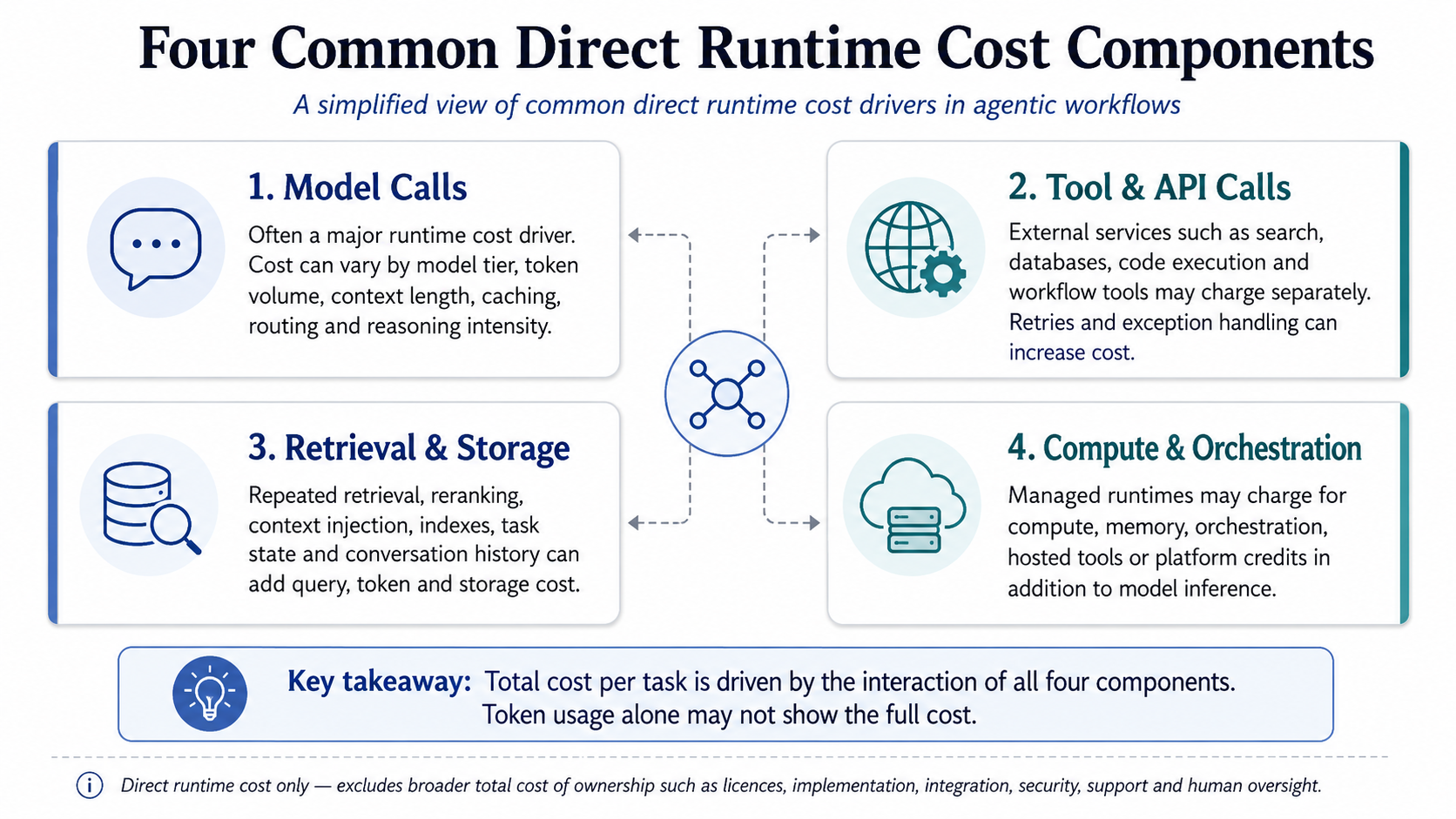
Tool and API calls. Agents may use external services such as search APIs, classification services, code-execution environments, databases and workflow platforms. These services can use charging units that differ from the model provider's token or credit units.
Retry and exception-handling logic can increase both tool consumption and model consumption. Because these costs may be reported through separate services, accounts or invoice line items, aggregate model-token reporting may not show the full direct runtime cost of the task. Per-trace attribution can help distinguish expected execution from retries, failures and exception paths.
Retrieval and storage. Agents that operate on enterprise information may retrieve context repeatedly during a task. Compared with a simpler retrieval-augmented generation flow, repeated planning, retrieval, reranking and context injection can increase retrieval operations and model-input consumption.
The financial effect depends on how the underlying services are charged, including whether consumption is measured through queries, tokens, storage, provisioned capacity or a hybrid structure. Storage of indexes, conversation history, task state and intermediate outputs may create additional ongoing cost.
Compute and orchestration. Some managed agent platforms charge separately for runtime compute, memory, orchestration, retrieval or hosted tools. Microsoft, for example, documents Azure AI Search agentic retrieval as involving agentic reasoning consumption and model tokens used for query planning and answer formulation, in addition to the underlying search service. Other managed runtimes may use measures such as compute time, memory, tool execution or platform-specific credits.
These components are often modelled separately from direct model inference because their billing units, allowances and controls can differ.
These four components interact. An agent that retrieves aggressively at each step may consume more retrieval resources and input tokens because retrieved context is commonly supplied to the model. A workflow that retries failed tool calls may also increase both model and tool consumption. The total cost per task is a function of the composition, not of any single component. These interactions mean that token consumption alone may not provide a complete view of task economics. Additional application or platform telemetry may be needed to associate model, tool, retrieval and runtime consumption with a completed task or outcome.
What Vendors Are Pricing and What They Are Not
The agentic AI pricing landscape is still developing, and several commercial structures currently coexist:
Token and tool consumption. Common in direct API and developer-platform deployments, where charges are based on model tokens and may include separate charges for hosted tools, retrieval or runtime resources.
Action, credit, conversation or outcome-based consumption. Usage is translated into vendor-defined business or platform units rather than exposed directly as tokens.
Per-user or bundled entitlements. Certain agent capabilities may be included within a user licence, platform subscription or unmetered entitlement, sometimes subject to product or channel restrictions.
Capacity and hybrid structures. Customers purchase or commit to a defined quantity of credits, throughput or capacity, with technical enforcement, overage, true-up or pay-as-you-go mechanisms depending on the product.
These structures are elaborated below.
Raw token billing. This structure is common in direct API and developer-platform deployments. Charges are based on model consumption and, where applicable, separate tool or service usage, regardless of whether that consumption arose from a single interaction or a multi-step agent run.
Providers may report token consumption at the request, project or account level, but that information may not map directly to the customer's business task, workflow, agent or outcome. Additional application telemetry may therefore be needed to aggregate multiple model calls and associated service costs into cost per completed task.
Per-action, per-conversation or per-outcome pricing. Under these structures, consumption is translated into a vendor-defined business or platform unit rather than exposed directly as model tokens.
Salesforce, for example, offers action-credit, conversation and user-based structures across parts of its Agentforce portfolio. Intercom uses outcome-based pricing for Fin, while Zendesk measures certain AI-agent usage through automated resolutions and resolution tiers funded through an allowance.
These structures may make the charging unit easier to interpret than raw token consumption, but they do not necessarily eliminate variability. Total cost may still depend on action counts, conversation volumes, outcome definitions, resolution classifications, included allowances, commitments and overage mechanics. Procurement teams may find it useful to examine exactly what triggers a billable unit and how that unit maps to the organisation's own definition of a completed task or business outcome.
Per-user or bundled entitlements. Some platforms include defined agent capabilities within a user licence, platform subscription or bundled entitlement rather than charging separately for every interaction. Other capabilities, channels or users may remain metered.
Salesforce currently offers user-based structures alongside consumption-based options. Microsoft supports prepaid Copilot Credit subscriptions, a one-year prepurchase plan and pay-as-you-go, while specified agent usage by Microsoft 365 Copilot-licensed users may be zero-rated in eligible Microsoft channels. The precise inclusions, restrictions and enforcement mechanisms vary by product and agreement and may be worth confirming directly with the vendor.
Capacity and hybrid structures. Customers may purchase or commit to a pool of credits, actions, throughput or capacity, with overage, true-up, pay-as-you-go or technical-enforcement mechanisms applying once the relevant entitlement is exhausted.
A key procurement issue is the relationship between the vendor's charging unit and the customer's own definition of a task or outcome. Under an action-credit model, for example, one customer-defined workflow may trigger multiple separately measured actions. The commercial model is therefore best tested against realistic end-to-end scenarios rather than interpreted solely from the name of the billing unit.
Telemetry and attribution vary between platforms. Some providers expose token consumption, while others report credits, actions, conversations, outcomes or resolution units. Procurement teams may find it useful to assess whether the available telemetry can attribute consumption to the organisation's own agents, tasks, use cases, cost centres and outcome definitions.
OpenTelemetry's GenAI semantic conventions provide an emerging cross-platform approach for recording model calls, token usage, tool execution and agent traces, although the conventions and supporting implementations remain under active development.
Detailed tracing can capture prompts, retrieved content, tool arguments and outputs. Organisations may therefore find data classification, access, retention, security and privacy requirements to be a relevant consideration when determining what telemetry is recorded. OpenTelemetry specifically notes that content capture can include sensitive information and is not enabled by default.
Without task-level attribution, an organisation may be limited to aggregate consumption and spend monitoring. This can make it harder to identify which workflows, execution paths or outcomes are driving cost. Organisations evaluating agent platforms may therefore consider cost and trace attribution as part of their commercial and technical assessment rather than relying solely on post-deployment reporting.
What This Changes for Labour Economics
The fixed-to-variable shift also changes how organisations think about the relationship between AI cost and labour cost, though the degree of change varies significantly by sector, role, and task complexity.
Under a largely fixed licence model, the incremental vendor licence charge associated with additional use may be low within the purchased entitlement. That does not make every AI-handled task a net saving: implementation, integration, human review, exception handling, quality failures and retained operating costs are separate factors that can offset the apparent saving.
Under a consumption-based agentic model, the direct runtime cost of each task becomes more visible. A useful comparison is often the fully loaded cost of the alternative process, including labour, existing automation, service levels and error handling, rather than either the AI licence price or labour cost in isolation.
Agentic automation may create value through capacity release, faster processing, increased throughput, improved availability or reduced manual effort. Whether this translates into a financial saving depends on whether those benefits are realised and whether existing costs are actually removed, avoided or productively redeployed.
Adoption Timing Is Also an Economic Decision
Delaying adoption may carry an opportunity cost where agentic workflows can materially improve a proven business process. Premature adoption can also create reliability, governance, integration and cost risks.
The appropriate timing depends on use-case economics, technology maturity, market conditions and organisational readiness. A balanced investment case can model both adoption and delay scenarios rather than assuming that either immediate deployment or continued deferral is inherently preferable.
How to Structure the Investment So It Is Governable
The following controls can improve an organisation's ability to monitor and manage cost exposure, although their relevance may depend on the platform, use case and deployment architecture.
Per-run resource limits. Depending on the platform, limits may be expressed as tokens, steps, elapsed time, tool calls, credits or monetary spend. These controls can reduce exposure to runaway execution, although limits set too aggressively may terminate legitimate tasks. Thresholds are often informed by pilot data, task criticality, failure consequences and the organisation's tolerance for incomplete execution.
Circuit breakers. Automated controls that halt an agent when it enters a loop, exceeds a step count, or triggers a threshold on tool call volume. Circuit breakers are a platform capability that varies by vendor. The enterprise AI spend caps and budget controls framework applies here, with the addition that agentic workloads often benefit from controls at the individual run level, not just at the application or user level.
Task-level observability. Instrumentation may be used to associate model calls, tool calls and retrieval operations with the business task that triggered them. This can help organisations understand why consumption occurred and identify unusually expensive or inefficient execution paths.
The available level of attribution is a relevant vendor and architecture consideration, particularly where organisations aim to allocate consumption by agent, use case, project, team or cost centre.
Model routing within agent chains. Different steps may call for different levels of model capability. Routing suitable steps to lower-cost models can reduce consumption, but the effect is often best evaluated at the level of successful task completion. A cheaper model that creates more retries, failures or human review may not produce the lowest overall cost per successful outcome.
Pilot design that produces cost data. Pilot data can provide useful evidence about task volumes, execution paths and consumption distributions before wider deployment. Relevant measures may include median cost, higher-percentile cost, maximum observed cost, completion rates, retries and human-review requirements.
The measures selected are typically matched to the proposed use case and commercial model. Aggregate token consumption alone may not show how consumption relates to particular tasks or successful outcomes.
The Procurement Questions Worth Asking
When evaluating vendors or platforms for agentic AI capabilities, several questions tend to surface useful information beyond the standard procurement checklist.
- How does the platform attribute consumption or cost to individual agent runs?
- Which charging units are used, and what event triggers each unit?
- What controls exist for tokens, credits, steps, elapsed time, tool calls or monetary spend?
- What happens when an agent reaches a resource or consumption limit?
- Can model, tool, retrieval and runtime consumption be associated with the same task or trace?
- Who controls model selection and routing?
- How are retries, failed executions and incomplete outcomes treated for billing purposes?
- Are prepaid, committed, capacity, per-user or outcome-based alternatives available?
- How do vendor-defined actions, conversations or outcomes map to the organisation's own business process?
- What usage data can be exported for internal reporting and financial attribution?
The answers can help determine whether the platform provides pricing visibility, controls and telemetry appropriate to the proposed use case and risk profile. Relevant agentic-specific criteria may also be incorporated into the organisation's broader enterprise AI vendor evaluation framework.
This article provides general commercial and procurement commentary only and does not constitute legal, financial, technical, or other professional advice. Vendor pricing models, charging structures, product capabilities, and market practices are indicative as at the last reviewed date and may change without notice. Organisations should verify current commercial terms directly with vendors and seek advice appropriate to their circumstances before making procurement or investment decisions.
Market examples and pricing structures referenced above are illustrative and do not represent every available commercial model. Cost behaviour and financial outcomes can vary materially by use case, architecture, implementation, controls and contractual terms.
Last reviewed: 19 July 2026