
The Shift Toward Consumption Pricing: What It Means for Enterprise AI Cost Modelling
Enterprise AI pricing is becoming more complex. Per-seat models remain common, but vendors increasingly use consumption, capacity and hybrid structures. This guide explains four common approaches and what they mean for cost modelling, forecasting and governance.

The invoice does not match the approval. That is the moment many finance teams discover that enterprise AI pricing has changed underneath them.
For thirty years, a software contract could be approved on a known per-seat price multiplied by a forecastable headcount. The number that came out of that calculation was the number that hit the budget, give or take a small variance. Enterprise AI is complicating that calculation for a growing share of vendor relationships. Vendors that once quoted a single per-seat figure now often quote a mix of base fees, consumption charges, capacity commitments, and overage rates. Some have moved largely to consumption models. Others have built hybrid structures that look familiar on the cover page and behave differently in production. Flat per-seat pricing remains common in productivity-tier and point-solution products, but where usage runs high relative to price, the economics underneath those quotes can come under pressure.
This article is written for IT, finance, procurement, and business leaders in Australian organisations who are building or defending enterprise AI cost models under pricing structures that no longer behave like per-seat software. It sits inside the broader work on enterprise AI total cost of ownership and connects to the enterprise AI procurement work that happens before vendor evaluation.
The Short Version
A useful way to understand enterprise AI pricing is to separate four points.
- Enterprise AI pricing has two related dimensions: the charging basis, which determines what the price is calculated against, and the commitment structure, which determines how much expenditure or capacity is committed in advance. A single vendor offer may combine several charging bases and commitment structures.
- Different structures create different financial risks. Pay-as-you-go consumption exposes the customer to changes in usage and cost. Prepaid credits and provisioned capacity can make expenditure more predictable but create commitment and underutilisation risk. Hybrid models combine elements of both.
- For variable and multi-meter arrangements, headcount alone is usually insufficient for cost modelling. Forecasts may need to include usage scenarios, relevant charging meters, committed capacity, included allowances, overage and regular comparison of actual usage against forecast.
- Commercial value is determined by more than the headline unit rate. Important variables may include included usage, thresholds, overage rates, commitment flexibility, true-down rights, spend caps, pricing protections, renewal terms and access to sufficiently detailed usage data.
The rest of this article works through each of these in turn.
Why the Shift Is Happening
The shift reflects the structure of enterprise AI delivery costs.
Traditional software generally had a low marginal delivery cost. Adding a user did not meaningfully increase the vendor's infrastructure cost, which made flat per-seat pricing rational for both sides. Enterprise AI does not behave that way. Every query consumes compute. Reasoning models can use more compute than standard models, particularly on complex tasks. Longer inputs increase the compute consumed, and multi-step agentic workflows can generate substantially more activity than a single prompt and response. Under flat per-seat pricing, light users may consume only a small amount of compute while heavy users consume substantially more, so the flat price cross-subsidises the heavy users. As adoption and workload intensity grow, this can place pressure on the economics of a fixed-price model.
Consumption pricing aligns vendor revenue more closely with measured usage, although the charge typically also incorporates platform functionality, support, orchestration, risk, and margin rather than directly reflecting the vendor's underlying compute cost. In doing so, it can transfer more usage-variance risk from the vendor to the customer. That transfer is what many finance teams are still adjusting to, and it is the lens the rest of this article uses.
The Two Dimensions That Explain Any Vendor's Pricing
Vendor pricing in enterprise AI is best read along two separate but related dimensions rather than as a single list of alternative models.
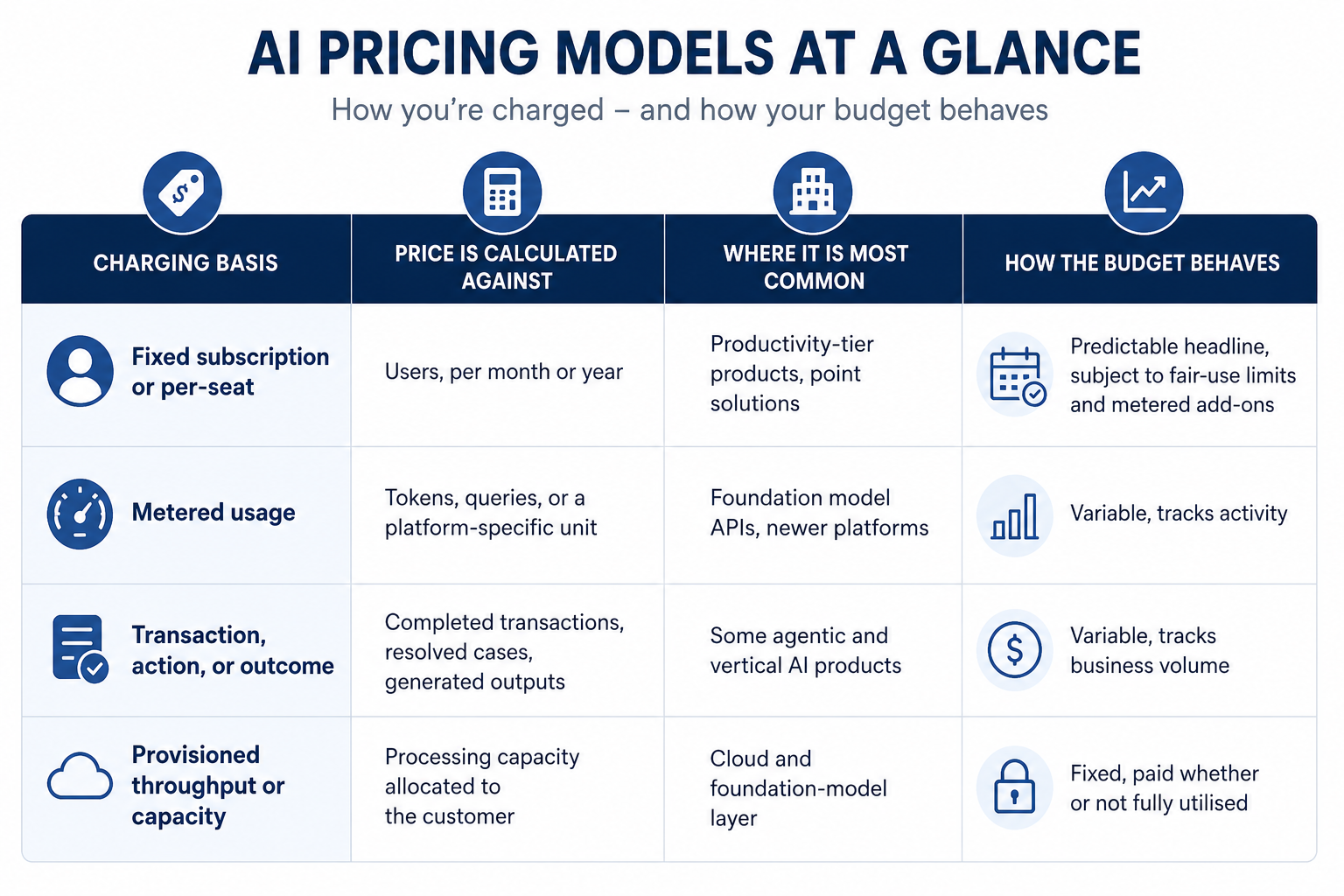
The first dimension is the charging basis: what the price is actually calculated against.
The second dimension is the commitment structure: how much of that charge is fixed in advance versus tied to what is actually consumed.
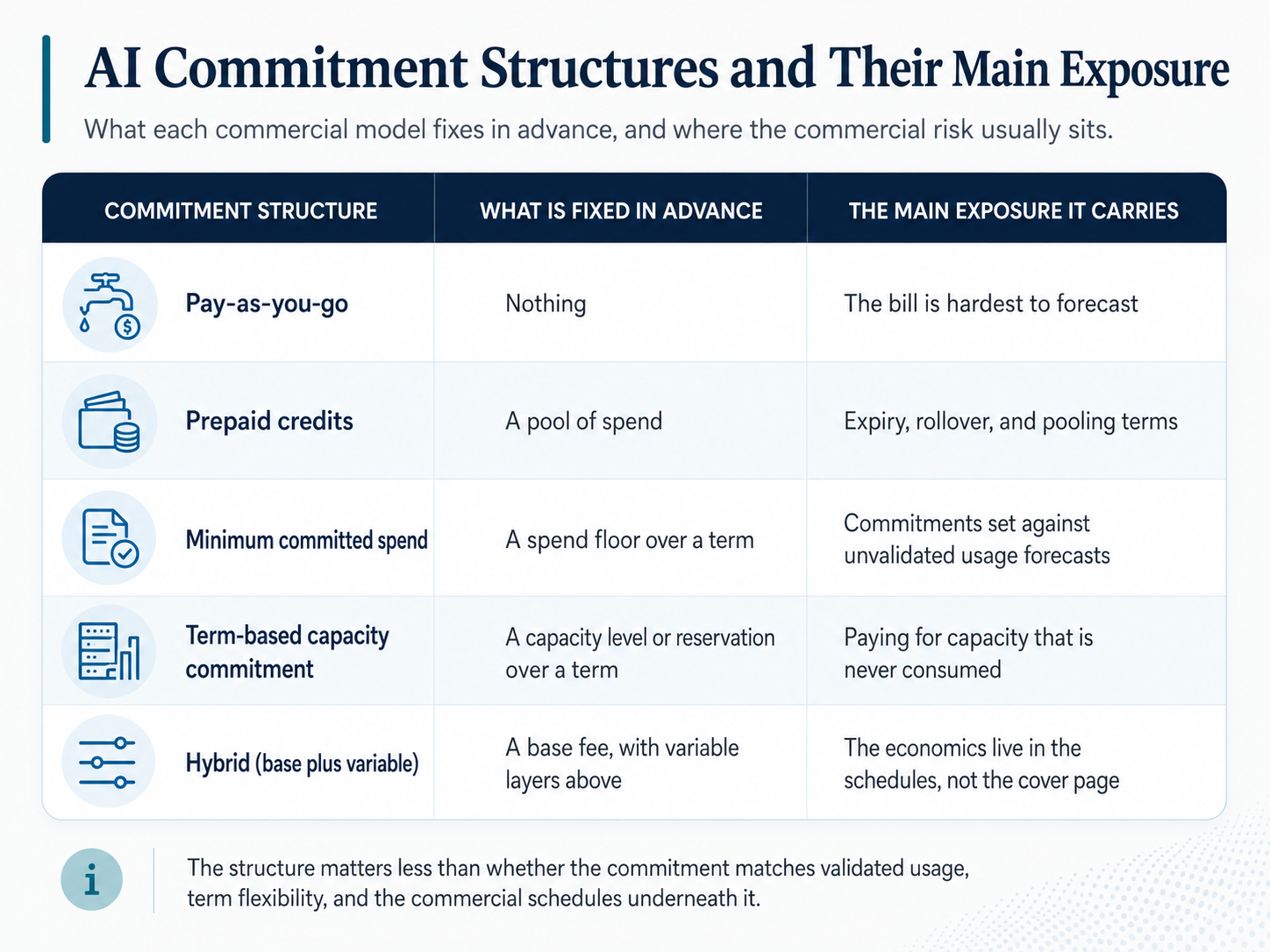
The two dimensions interact rather than operating independently: a term-based capacity commitment, for example, generally attaches to provisioned capacity. A single vendor arrangement also often occupies several cells at once. A product can charge a base seat fee, include a bundle of usage inside that fee, sell prepaid credits for usage beyond the bundle, apply overage rates once the credits run out, and separately offer provisioned capacity for predictable high-volume workloads. Mapping both dimensions for a given offer produces more useful information than trying to place the vendor into a single category.
Per-Seat Is Not One Thing
The "fixed subscription" label covers several structurally different arrangements, and the label alone does not indicate which one a vendor is offering:
- A genuinely fixed seat, with no chargeable overage at all. The budget stays predictable. Utilisation, model-access limits, and the risk of the structure changing at renewal remain the open questions.
- A seat with fair-use or rate limits, which cap usage without additional charge. The cost is fixed but the capability is not.
- A seat with optional usage credits, purchasable once included limits are exceeded. The headline is fixed; the actual spend may not be.
- A seat bundled with separately metered services, such as agents, tools, or platform functions charged on consumption alongside the seat.
These carry materially different budgeting implications. A fixed-seat AI vendor is also absorbing cost variance that consumption-priced vendors pass to the customer. To manage that exposure at scale, vendors may limit usage, restrict access to higher-cost models, price the seat for average consumption, or introduce credits and metered extensions alongside the seat. Several vendors now combine fixed subscriptions with credits or separately metered services, which indicates a visible movement toward hybrid structures in parts of the market, although pricing approaches continue to vary by vendor and product.
The Other Charging Bases in Brief
Metered usage charges against what is consumed, most commonly at the foundation model API layer and increasingly at the platform layer. The unit may be tokens, queries, or a vendor-defined credit, and a vendor-defined credit does not necessarily reveal the underlying compute economics. A metered basis can also sit under any of the commitment structures above: at the time of writing, Microsoft sells Copilot Credits through a pay-as-you-go meter, prepaid capacity packs, and an annual pre-purchase plan. Metered pricing can make the relationship between activity and expenditure more visible. Pay-as-you-go arrangements may be attractive where demand is initially uncertain, while prepaid or committed arrangements carry under-consumption risk. At enterprise scale the bill is less predictable, and the forecasting involves usage modelling most organisations have not done before.
Transaction, action, or outcome pricing charges according to a defined event or result rather than directly against underlying compute usage. The unit might be an agent action, a customer conversation, a processed document, or a resolved case, and these units are not equivalent: a completed action does not necessarily mean the intended business outcome was achieved. This basis is emerging in agentic and vertical products where a resolved case is a more legible unit for the customer than a token count, and publicly documented examples exist at the time of writing, including per-resolution pricing for AI customer service agents. These structures may make the charging unit easier for the customer to understand, but what triggers a charge, including the treatment of failed actions, retries, escalations, and disputed outcomes, varies by vendor and materially affects the effective price.
Provisioned throughput or capacity allocates a defined amount of processing capacity to the customer, paid whether or not it is fully utilised. It is common at the cloud and foundation-model layer and is often chosen for predictable throughput and a stable cost envelope. A term reservation or commitment can reduce the effective price of that capacity, but the financial reservation is distinct from the capacity allocation itself: on some cloud platforms, a reservation is a billing discount that does not by itself guarantee capacity availability. The trade-off is utilisation risk.
What a Hybrid Offer Looks Like in Practice
For illustration only, consider a 500-seat deployment on a hybrid structure: a base fee of approximately $30 per user per month, a bundled usage allowance sized to roughly 80 percent of forecast usage, and overage charged at a defined per-unit rate above the bundle. The figures below are modelled examples, not vendor pricing.
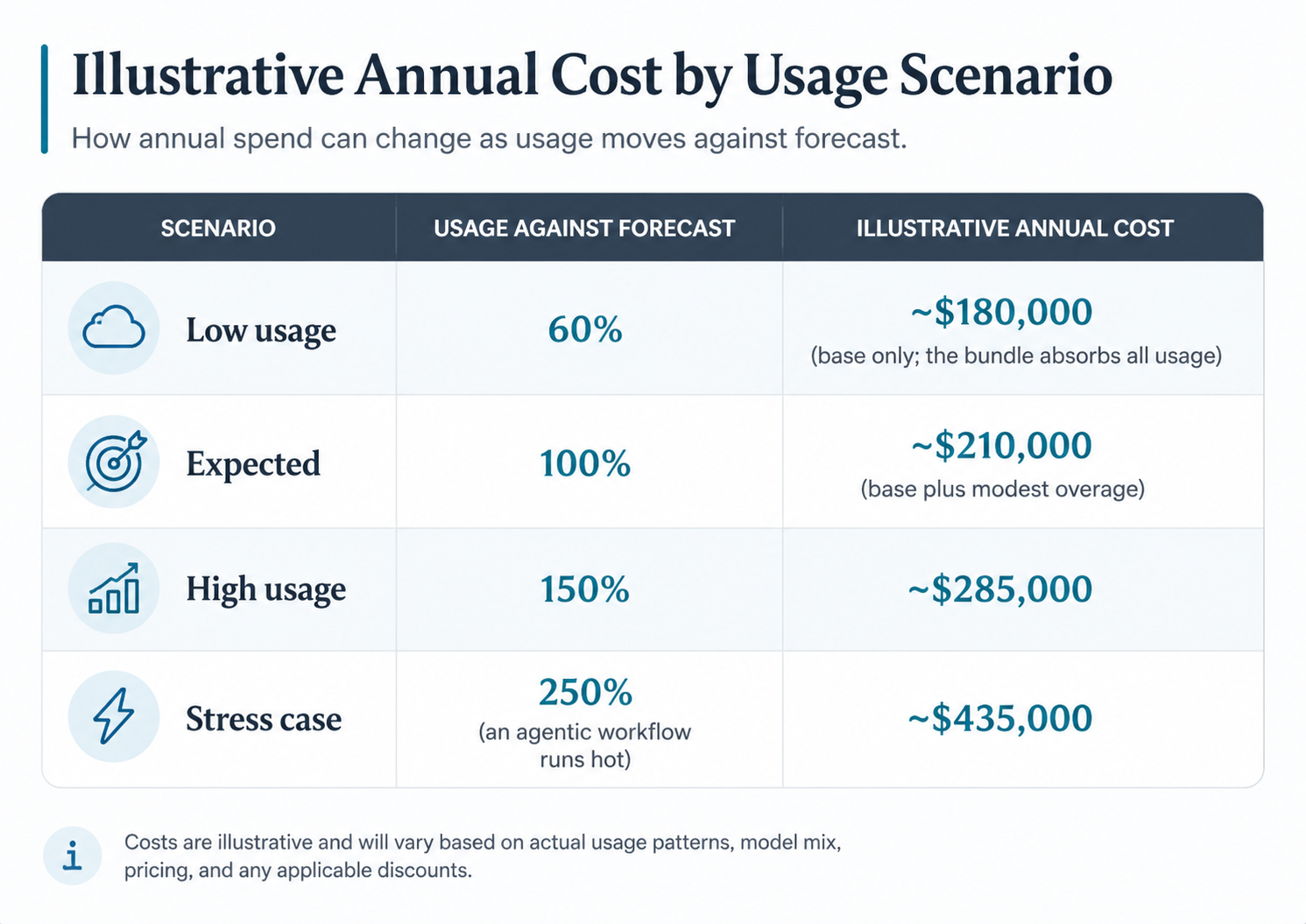
The base fee is the only figure that behaves like a traditional licence. Everything else depends on usage, and the terms that determine the spread between the scenarios, threshold definitions, overage rates, carry-forward of unused entitlement, sit in the schedules rather than on the cover page. In practice, the headline per-seat figure often receives the most procurement attention while the consumption mechanics that drive the variable cost receive less.
A hybrid structure can be a sound deal. The judgement lives in the schedules.
What This Means for Cost Modelling
For genuinely fixed per-seat arrangements, the old models remain broadly adequate: seats multiplied by price and term, adjusted for deployment timing, growth, and attrition. What the fixed-seat model does not capture is utilisation and value: whether purchased seats are used, whether usage is approaching fair-use limits, and whether the spend delivers the expected benefit.
For consumption, capacity, and hybrid structures, the pre-AI models are materially less adequate, because the number that hits the budget is no longer a function of headcount. A useful cost model separates four distinct questions: what will be invoiced (budget forecasting), what activity is expected (usage forecasting), what a unit of work costs (unit economics), and whether the expenditure delivers the expected benefit (value realisation). Fixed per-seat pricing simplifies only the first question. Four changes follow.
From Headcount-Driven to Usage-Driven Forecasting
Per-seat models were headcount-driven: forecast headcount, multiply by price, add inflation, done. Consumption models involve usage forecasts at a granularity most organisations have not previously produced. Queries per active user per day. Tokens per query. The proportion of queries hitting reasoning models versus standard models. Agentic task patterns across the user base.
These inputs do not come from a budget spreadsheet. They typically come from pilot instrumentation that captures usage patterns realistically and projects them at scale. The connection to enterprise AI pilot design is direct: a pilot that does not produce usage telemetry at forecasting granularity is a pilot whose budget number is harder to defend at the next stage.
Consumption Is Rarely a Single Meter
Cost models that focus solely on token or query volume tend to understate the eventual bill. A single enterprise AI contract can meter several of the following at once:
- Compute meters: input and output tokens (often priced separately), cached or prompt-cached input, reasoning or premium-tier model usage, code execution or containerised environments.
- Platform service meters: web search and grounding, tool and API calls, retrieval and vector storage, file or data storage, agent orchestration, guardrails and evaluation services.
- Commercial and structural items: provisioned throughput or reserved capacity, regional or data-residency premiums, support and platform fees, and foreign exchange exposure where the contract is priced in a currency other than Australian dollars.
Which meters apply depends on the vendor's rate card and the deployment architecture. Not every product contains every meter, and cost models built from the vendor's actual pricing schedule tend to be more reliable than models extrapolated from token volume alone.
From Single-Point Forecasts to Scenario Ranges
Under per-seat pricing, the forecast was a single number with a small variance band. Under consumption pricing, single-point forecasts mislead. The realistic cost is better expressed as a set of scenarios, as in the illustration above: a low-usage floor, an expected case, a high-usage case, and a stress case reflecting a product launch, a seasonal spike, or an agentic workflow running beyond its intended bounds.
Finance teams who have not seen this shape of forecast before often find it uncomfortable. The discomfort is appropriate, because it reflects the risk transfer described earlier. In practice, some organisations budget against the expected scenario and put governance in place for the high and stress cases. Others collapse the range to a single number, which tends to produce surprises in either direction.
From Annual Approval to Continuous Cost Governance
Fixed per-seat arrangements can generally be forecast through periodic licence reviews. Consumption and hybrid arrangements usually require more active governance because usage, overage and expenditure may change during the term. Prepaid or provisioned-capacity structures can stabilise invoiced cost, but still require monitoring to manage utilisation and commitment risk.
Where Commercial Leverage Actually Sits
A common assumption among procurement teams new to consumption pricing is that the per-token or per-query rate is the primary negotiation lever. The landscape is more nuanced, and it differs by layer of the stack. How much leverage a customer has depends on the vendor, the purchasing channel, the customer's volume, the contract term, the size of any committed spend, the competition for the account, and the timing of the negotiation. The framework below is a starting point for mapping where leverage is more or less likely to sit rather than a fixed rule.
At the foundation model layer (direct relationships with model providers), per-token rates have historically been negotiable at scale, with discounts tied to committed annual spend. The picture at the time of writing is mixed, and commercial positions vary materially by provider, account size, purchasing channel, and commitment level. In some arrangements leverage sits in the unit rate itself. In others, the greater opportunity lies in committed-spend discounts, included consumption, capacity arrangements, or protections around future pricing. Positions can also change between initial contracting and renewal, so the negotiation approach that worked in the previous term may not be available in the next one.
At the cloud channel and including Azure, AWS and Google Cloud published consumption rates are generally standardised. Effective pricing may be influenced by negotiated enterprise discounts, private offers, committed-spend arrangements and provisioned-capacity or reservation products.
These mechanisms are not interchangeable. For example, a Microsoft Azure Consumption Commitment establishes a minimum spending commitment and determines which expenditure counts toward it, but does not by itself constitute a unit-rate discount. The commercial leverage lies in the combined pricing, discount, commitment, capacity and drawdown structure.
At the platform layer (enterprise AI platforms that sit on top of foundation models), the unit rate the customer sees bundles model access, orchestration, governance, retrieval, and margin, and is rarely a pass-through of the model provider's price. Customers who negotiate platform rates as if they were foundation-model rates often find limited movement. At this layer, total deal economics tend to matter more than unit rates: bundled allocations, included entitlements, base fees, overage rates, and renewal protections, structured as a package against committed spend.
The broader pattern: in many negotiations, leverage is shifting away from the headline unit rate and toward the mechanics that determine what the rate is multiplied by, what protects it through the term, and what happens when the structure changes underneath the contract.
The Contract Mechanics That Vary Most Across the Market
Given where the unit rate sits in each layer, the terms that differ most between contracts, and that materially affect total cost, are the following. These are commercial patterns observed across the enterprise AI market, not guidance on the content of any organisation's contract. Organisations should always seek legal advice specific to their circumstances before relying on any contract terms.
Threshold definitions. What usage is included in the base, what triggers overage, and how overage is measured vary across contracts. Vaguer definitions leave more discretion in how they are interpreted.
Overage rates. Some contracts apply a higher per-unit rate to overage than to in-bundle usage. Some procurement teams test multiple usage scenarios above the base forecast to understand potential overage exposure and determine whether the resulting cost remains within the organisation’s approved risk and budget parameters.
True-up and true-down rights. Contracts vary in how they handle usage that falls short of or exceeds the commitment. Some offer symmetric adjustment. Others adjust in one direction only, typically the vendor's.
Cap structures. Whether a contract includes a mechanism to cap monthly or annual spend, and what happens when a cap is hit, differs by vendor and tier. The mechanics are covered in the enterprise AI spend caps and budget controls work.
Pricing changes during the term and at renewal. These are separate risks. Contracts vary in whether they define the vendor's ability to change consumption rates, model availability, credit values, or included entitlements mid-term, the notice involved, and any customer adjustment rights. At renewal, a vendor may propose a materially different structure even where the current term was protected. Market practice on renewal exposure also varies: some contracts include advance-notice terms, renewal price protections, benchmarking or reopener rights, and defined exit timeframes. Others are silent on all of these.
Commitment obsolescence. Under-consumption is not the only risk in a capacity or spend commitment. The other is locking in spend while model price-performance continues to improve, leaving the customer paying an older rate for capability the market has since repriced downward. Terms observed to vary across the market include: whether unused credits expire or roll over; whether they pool across teams and use cases; whether commitments transfer between models, services, and regions; what happens on model deprecation or substitution; how unused commitments are treated at term end; and whether pricing adjusts when the vendor's published rates fall.
Usage data access and reconciliation. The vendor typically creates and operates the underlying telemetry. Timely access is often the immediate operational issue, but ownership, permitted use, confidentiality, privacy, retention, and export rights remain contract-specific considerations that vary across the market. Granular access, with sufficient attribution detail to allocate cost internally and to reconcile invoices against independent records, is what allows a customer to manage spend on its own terms. Vendors who provide only summary invoices limit that ability, which also weakens the customer's position at renewal.
How the Shift Affects Build vs Buy
The pricing shift also changes the enterprise AI build vs buy calculation. Historically, the buy case often rested on a CFO-friendly argument: the vendor's price was predictable, while the API, infrastructure, and engineering costs of building internally were not, so buying carried the lower budget risk. Under consumption and hybrid pricing, that argument is weaker than it looks on a slide, because the bought platform's cost may now be nearly as variable as the built one's.
The comparison does not reduce to matching shapes, however. Internal engineering labour is economically different from a contractual minimum commitment: labour may be reusable across use cases and already on the payroll, whereas a capacity commitment can become stranded spend if usage does not materialise. Buying has also always covered more than cost certainty: time to value, product functionality, integration work already done, security and compliance capability, support obligations, and ongoing model and product development that an internally built system does not automatically carry. The question surfacing more frequently in procurement is which path's variability the organisation is better placed to manage, and what the organisation is paying the vendor for beyond cost certainty.
Four Patterns That Can Produce Avoidable Surprise
Across enterprise AI procurements that have moved to consumption pricing, four patterns recur in the customers who experience the bill as a surprise.
Approving on headline-rate comparison. The vendor with the lowest per-token or per-query rate looks cheapest on a comparison table. Total cost is the rate multiplied by usage, and usage is often easier to influence in some platforms than others. The headline rate is one input among several.
Treating the forecast as a budget. A budget is what the organisation has approved to spend. A forecast is what it expects to spend. Under consumption pricing the two diverge whenever usage moves, and treating them as the same number removes the governance layer that would otherwise sit between them.
Operating without instrumentation at the level the contract is priced at. If the contract is priced per token, token-level visibility is the relevant instrumentation, with cost attribution to teams or applications. Customers who rely on vendor invoices to understand their own usage are governing on a lag, and the lag is where the surprise lives.
Operating without granular consumption controls. Aggregate caps at the contract or tenant level protect against the worst-case bill, but not against a small number of heavy consumers using a disproportionate share of the budget before anyone notices. Automated or poorly controlled agentic workloads can generate disproportionate consumption rapidly, through looping prompts, retrieval against very large contexts, or an agent chain running longer than intended. In agentic deployments, consumption may originate from agents, applications, workflows, API keys, or service accounts rather than identifiable users, so a control hierarchy limited to per-user caps misses a growing share of spend. Platform capability varies here: some platforms enforce per-user, per-agent, or per-workflow caps in real time, with alerts and circuit breakers; others offer only tenant-level controls, a single circuit breaker for the whole estate.
The Executive Takeaway
The shift from fixed per-seat pricing to consumption, capacity and hybrid models changes who carries the risk when usage differs from forecast.
Where the shift is not actively managed, actual costs may exceed the approved budget as adoption and usage grow. Organisations may also commit to more capacity than they use, lack sufficient data to validate invoices, or enter renewals without a clear view of future demand.
Where the shift is actively managed, cost models test multiple usage scenarios rather than relying only on headcount. Commercial reviews focus on included usage, commitments, overage rates, spend controls, pricing-change provisions and access to usage data. Actual consumption is then monitored against both the forecast and the approved budget.
The key change is straightforward: enterprise AI costs can vary with usage. Procurement, finance and operational teams therefore need to manage usage assumptions, commercial commitments and ongoing expenditure together rather than treating the contract as a fixed annual software cost.
This article provides general commercial and procurement commentary only and does not constitute legal, financial, technical or other professional advice. Vendor pricing models, charging structures, product capabilities and market practices are indicative as at the date of publication and may change without notice. Organisations should verify current commercial terms directly with vendors and obtain advice appropriate to their circumstances before making procurement or investment decisions.